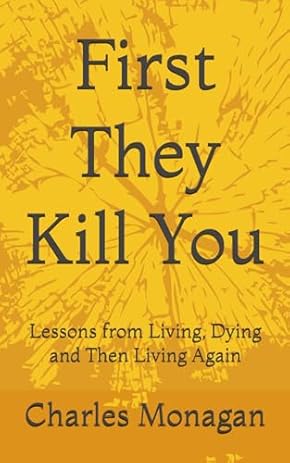
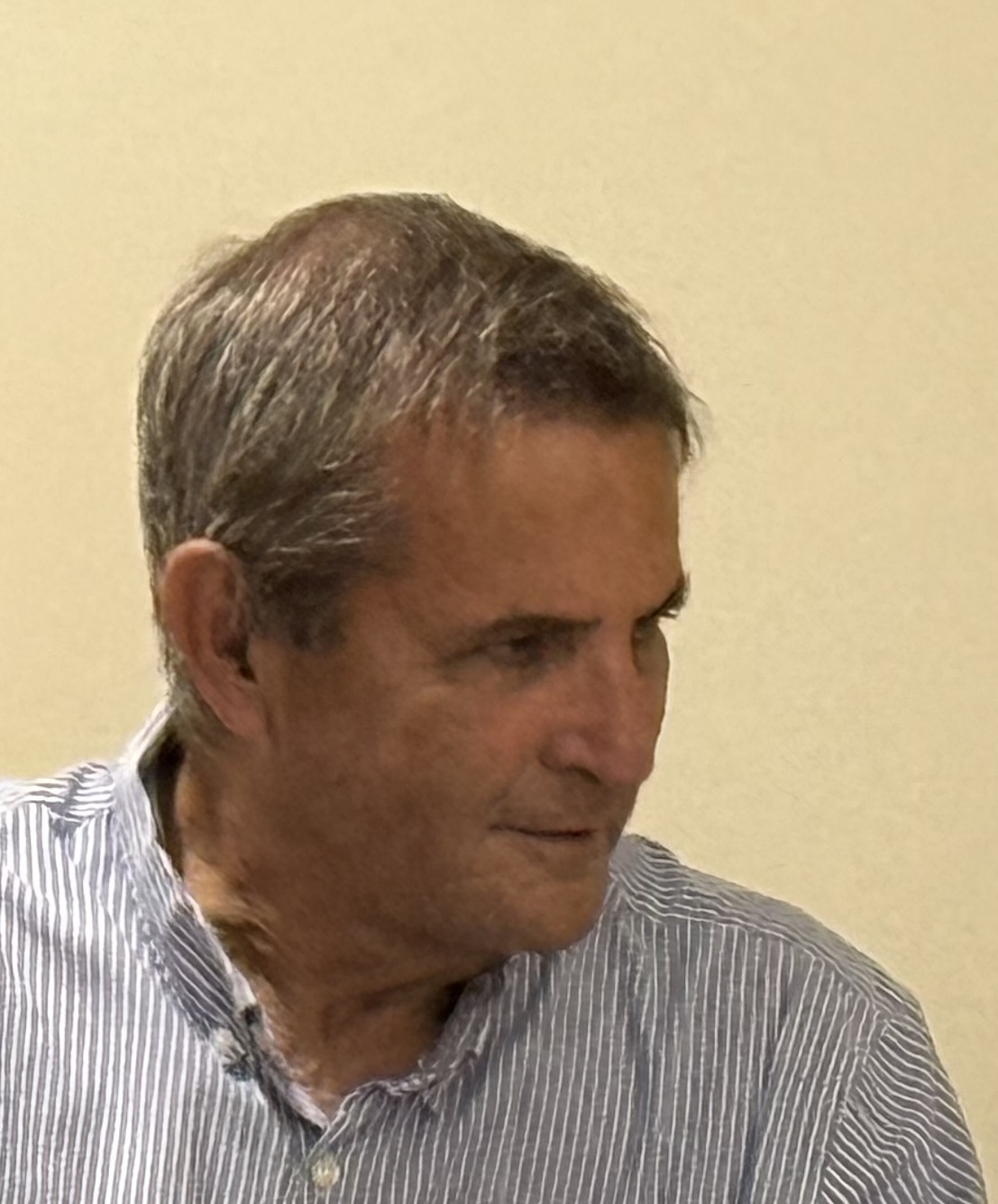
Sure you can read my medical memoir “First They Kill You” by scrolling down this page, but now you can also see it in book form, the way God intended it. It’s the story of my long duel with blood cancers and the ultimate (so far) triumph through the miracle of stem cell replacement. The book’s got pain, suffering, humor, vivid nightmares, helpful hallucinations and lots of different people being brilliant and wonderful. What I thought might be a terrifying memoir turned out to be a love story. How? See for yourself! https://www.amazon.com/dp/B0FY51DQNV?ref=author_qv_ov_prnt_dp_rw
My Pop and Rock Favorites After a Lifetime of Listening
Nothing could be less controllable than trying to come up with your own all-time Top 20. As time goes by, songs rise and fall away, new songs demand a place, sure things suddenly don’t sound quite so great and forgotten beauties spring to mind. Only a true handful of songs, it seems, remain secure and unmovable. Still, it can be fun to make a list and invite both appreciation and scorn.
My list was initiated in a New York hospital room where I was recovering from a stem-cell replacement procedure. My brother Michael was visiting from California. He and I are 18 months apart in age, each with a lifelong interest in music, he very much as a performer and me as a devoted listener. At some point, we got onto the subject of our favorite songs from the pop, rock and soul realms. I promised him a list of my Top 20 and, two years later, here they are. In devising my list, I wasn’t looking for obscurities or deep album cuts. I picked from among songs that were singles or could have been.
You ask how can there be nothing here by Michael Jackson, The Pretenders, Marvin Gaye, Joni Mitchell, Stevie Wonder, Laura Nyro, Talking Heads, Elvis Costello or Crabby Appleton? I don’t know. Get back to me in a week and things might look different.
Finally, the songs are not listed in order of preference. It’s random. And I snuck in a couple of double entries. Fair enough?
Penny Lane by The Beatles
Raspberry Beret by Prince
There are so many perfect upbeat pop songs out there. At the moment, off the top of my head, I’m thinking of “Another Nail for My Heart” by Squeeze, “Starry Eyes” by The Records and “I Only Want To Be With You” by Dusty Springfield followed by hundreds of others. But I love these two songs not only for their poppy musical perfection, but also because of the similar stories they tell – of youth, of eyes wide open, of the small, simple beauties of the world. The details can only be authentic. In Prince’s formative days in Minnesota, there’s Mr. McGee’s five-and-dime, Old Man Johnson’s farm, the stunning, beret-capped honey brazenly, boldly, beautifully coming in through the out door; in McCartney’s Liverpool, we meet the barber, banker, fireman and pretty nurse all beneath the sheltering skies of Penny Lane. It’s true that Prince is singing about his first time, while McCartney is merely recalling a simpler time, and that all those times are long, long gone now. But they’ve been caught on record like French stolen gems in amber, everlasting.
These Days by Jackson Browne
Who Knows Where the Time Goes? by Sandy Denny
How is it possible that two of the most poignant, sure-footed, everlasting songs about world-weariness and regret were written by teenagers? While most of their successful contemporaries were singing about surfing, first love and da-doo-ron-ron, Sandy Denny (19) and Jackson Browne (16!) were creating these two stories that would go on to crest all the coming decades, recorded by dozens of others, never losing an ounce of their power, and settling in finally on the very top shelf of songdom. For Denny, “Who Knows . . .” was the second song she ever wrote. She first performed it with The Strawbs and later, more familiarly, with Fairport Convention. It was also the last song she sang in concert before she died, at 31, following a trouble-plagued end of life and a fatal fall down stairs. The song of course lives on, its strengths evident from the achingly familiar first lines (you’ve no doubt heard Judy Collins singing them):
“Across the morning sky all the birds are leaving,
Ah, how can they know it’s time for them to go?
Before the winter fire, we’ll still be dreaming,
I do not count the time.”
Meanwhile, Jackson Browne’s tribute to loss and regret demonstrates that perhaps no one is more attentive and sensitive to such things than a watchful teenager. “These Days” was first recorded in 1967 by Nico and since then by everyone from Cher to Fountains of Wayne to Drake and Miley Cyrus. Again, the opening lines hold up powerfully across the passage of time, capturing a somber, semi-alienated mood that most of us have perhaps known and understood:
“I’ve been out walking,
I don’t do too much talking these days,
These days . . . these days I seem to think a lot
About the things that I forgot to do
And all the things I had a chance to.”
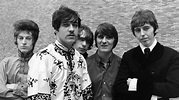
A Whiter Shade of Pale by Procol Harum
I’ve heard it hundreds of times by now, but I never get sick of “A Whiter Shade of Pale.” It may be the only song that I’ve heard so many times and yet still look forward to hearing again. I associate it with the summer of 1967, just after it was released and began its swift climb to the top of the charts. I was 17, working at Burger Chef and playing summer baseball, and certainly aware that the world out there beyond the dashboard of my Corvair was rapidly turning upside down. With its powerful vocal and melancholy organ, its talk of a light fandango, and turning cartwheels across the floor, and a room that was humming harder as the goddamn ceiling flew away (not to mention allusions to Chaucer and Bach), this was one of those songs that made me want to find out where everyone was going so I could go there myself. Somehow it still makes me feel that way.
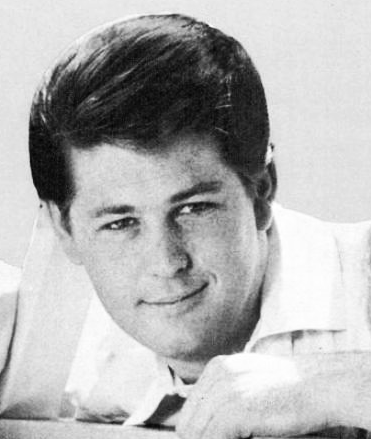
Don’t Worry Baby by The Beach Boys
I was 15 in 1965 when my family arrived in California as part of an all-summer, cross-country camping trip. We set up at Doheny Beach and I witnessed with wide eyes all of California’s promises coming true: surfers, Hell’s Angels, Disneyland, movie studios and even luminescent surf at night. Brian Wilson was central to all of this. A lot of boys my age wore wide-striped shirts and that summer’s hit, “California Girls,” filled the airwaves. I’d already been listening to the Beach Boys’ magic for a couple of years, and I’d continue for the rest of my life. As time went on back in my East Coast home, I came to fully appreciate Wilson’s talent and commiserate with his unsteady state of mind. And my favorite song of all, the flip side of 1964’s “I Get Around” that I hadn’t properly noticed at the time, was this creamy riff on teen insecurity. The song is half “Be My Baby” and half “Rebel Without a Cause,” but it’s all Brian Wilson. He takes the lead, paints the harmonies and tells the story of the boy who brags about his car, gets challenged to a dangerous race and finds reassurance, and more, in the arms of an unnamed fantasy angel. Some of his later songs won more acclaim, but this one was a flawless coming attraction of his blossoming genius.
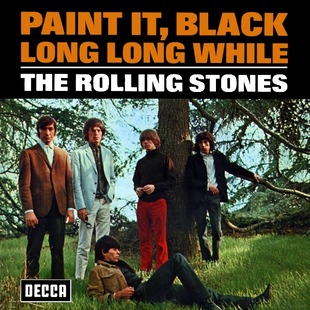
Paint It Black by The Rolling Stones
From rock ‘n’ roll’s very beginning, part of its attraction – and horror – was its sense of menace. The insistent bass, pounding drums, scorching guitars and urgent vocals all signaled danger – a wrong, reckless turn taken somewhere and possibly some good booze and unwise sex just up around the bend. The Rolling Stones were experts at mood and menace. From the start, they didn’t wear ties and jackets on stage like the other boys did, they appeared sullen with lit cigarettes on album covers and they played with a bluesy abandon that most other bands could rarely muster. With “Paint It Black” they laid out the startlingly unhinged story of someone who’s lost his love, seen her buried, and then plunged into an abyss of his own. He wants everything painted black. He wants the sun blotted out from the sky. He’s gone psycho. Meanwhile, the music, with its droning sitar, propulsive Middle Eastern vibe and Jagger’s snarling vocal never lets up. Overall, it’s as menacing a #1 pop hit as there’s ever been. I’ll never forget cueing up the Stones’ brand new “Aftermath” album in a summer lake cottage in 1966 and getting hit with this as the opening cut. For me, it turned out to be the song of the summer, and beyond.
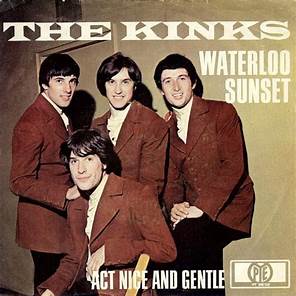
Waterloo Sunset/Days by The Kinks
The Kinks get a double entry because I love them and always have. Back in 1964-65, it was briefly a cool thing (among 14-year-olds) to claim to prefer someone else over The Beatles. For me, it was The Kinks. It began with the fantastic one-two power punch “You Really Got Me” and “All Day and All of the Night” but soon expanded, via Ray Davies’ vision, into songs of social commentary and a wistful longing for simple English pleasures and sunny afternoons. Into that mix came “Waterloo Sunset,” with its dirty old river, busy underground station, and mysterious Terry and Julie, all observed from afar by the flat-bound introvert at his window. It beautifully evokes the quiet enjoyment, even paradise, of being the observer rather than the participant, the play-watcher instead of the actor. Meanwhile, “Days” is a song that grows richer and more meaningful with time. A thank-you from Davies to his older sisters, who introduced Ray and his younger brother and future bandmate, Dave, to the pop music and dance halls of their youth, the song can serve also as a general thank-you to all we’ve met and loved in our lives. During a recent serious illness, I confided to my brother that this was the song I’d like him to sing to close out my memorial service, if it came to that. It didn’t, and soon after I read that this is what Ray Davies wants played at his own send-off. I suppose he wouldn’t mind if we both did it. But being Ray, maybe he would.
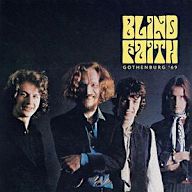
Can’t Find My Way Home by Blind Faith
It seems that Steve Winwood was 20 when he wrote this song, and I was 19 when I first heard it, in 1969, so maybe that’s why it’s stayed with me for so long: the brother scored a direct hit on me. I do know it’s another of those songs that, 55 years later, I still never get tired of hearing. Winwood’s plaintive vocal (remember, at 17 he’d been the voice of The Spencer Davis Group and “Gimme Some Lovin’) and maybe half-true situation (“I’m wasted, and I can’t find my way home”) spoke directly if a little hazily to my occasionally-immobile status: a candlelit room, me one or two over the line, curled up on a ratty couch, wondering by what clever devising I could get myself all the way across the room for a book of matches. Winwood may have had higher themes in mind (“come down off your throne and leave your body alone”), but I certainly did not.
Angel From Montgomery by Bonnie Raitt
Released in 1974, this is probably most people’s favorite version of the John Prine classic. Bonnie Raitt inhabits the “old woman” at the song’s center, the one dealing with a mountain of regret and who longs for escape but knows she’ll never manage it. She calls out for an angel to take her away from her broken life in Mongomery, or maybe just an old rodeo poster – anything to change up the emptiness of what she’s got now. Raitt’s reading of the song’s crowning lines (about the woman’s hopeless disappointment of a husband) is heartbreakingly perfect:
“How the hell can a person
Go to work in the mornin’
And come home in the evenin’
And have nothin’ to say?”
The subject matter of Prine’s best songs might be tagged as Kitchen Sink Songwriting, after the British cultural movement of the 1950s that included plays, movies and novels. Plain talking working class people, angry or disillusioned or down on their luck or just growing old, trying to find someone, or something, to hold onto. Nobody tells their stories better than Prine.
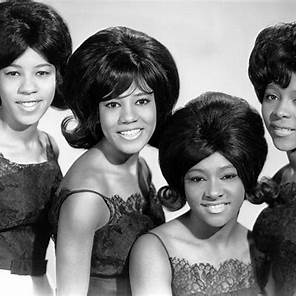
Then He Kissed Me by The Crystals
I remember hearing this song for the first time on the radio, grabbing a dollar from somewhere (probably my mother’s pocketbook) and running down the hill all the way to the center of town, beelining to the record shop, buying the .45 and then running back up the hill, returning home and putting it straight onto our turntable. At the time, 1963 (I was 13), I’m sure I never would have figured out why I’d acted so impulsively, but gradually it came to me: It was the first song ever to hit me below the belt. The thundering Phil Spector wall of sound, the sweet heat of the Ellie Greenwich, Jeff Barry lyrics and the exuberant lead vocal of Dolores “La La” Brooks moved me in ways I wasn’t familiar with. And when she freely confesses that she “gave him all the lovin’ I had,” I wasn’t quite sure what to think. There are many wonders in Spector’s stable, of course, some of the best stuff in the world, but this was the first for me, and you always remember the first one.
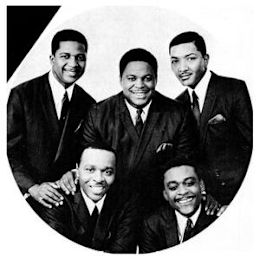
Stay in My Corner by The Dells
How good were The Dells? They were so good that in 1966 they were hired to open for Ray Charles during his concert tour but were summarily fired after one of their performances resulted in several standing ovations. You just aren’t supposed to step on the headliner’s shadow. But the group by then probably knew that; they’d already been around since 1955 and had enjoyed one monster hit in “Oh, What a Night.” Another, “There Is,” would come in 1967. But my favorite has always been 1968’s “Stay in My Corner,” an earnest, soulful plea about a man, maybe a man in trouble, needing the love, comfort and steadying presence of a woman. Most impressive and memorable about the song is the vocal of Marvin Junior, the group’s powerful, husky voiced baritone, who at one point hits a big, big note and stays on it for 17 seconds. Showing off, yeah, but why wouldn’t he?
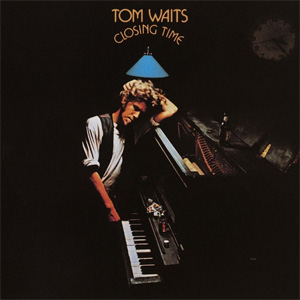
Grapefruit Moon by Tom Waits
No, I probably don’t know what this song is about, but it’s Tom Waits, and a rough and gorgeous sort of poetry, so I’ll just go along for the ride. This is one of the many lovely, smoky, melancholy songs to be found on Waits’ 1973 debut album, “Closing Time.” It’s easy to picture yourself seated, a drink in front of you, at a small table in an intimate half-empty jazz club, the guy up front bent over the keyboard, singing to himself, unable to forget:
“Grapefruit moon, one star shining,
Shining down on me,
Heard that tune, and now I’m pining,
Honey, can’t you see?
‘Cause every time I hear that melody
Well, something breaks inside,
And the grapefruit moon, one star shining,
Can’t turn back the tide.”
I’d love to know what the “melody” he’s talking about is, but I try not to let it bother me. Maybe he’s summoning Humphrey Bogart’s Rick Blaine in “Casablanca,” tortured by the memory of a woman and a particular song they shared. In any event, this tune, as with a number of Waits’ best, should be much more heard than it is.
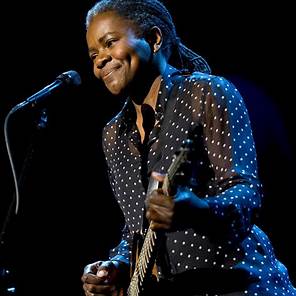
Fast Car by Tracy Chapman
I don’t think I’ve ever felt for someone in a song the way I felt for the singer of this one when I first heard it. Trapped unfairly in a world she didn’t create, caring for an alcoholic father after her mother ran off, she longs for escape – and not just in any car, but in a fast car. She succeeds, with a wonderful, fleeting, euphoric feeling of freedom, only to soon face new challenges in her new town. The cycle is hard to break but her continuing hope for a better future remains in a way that breaks your heart:
“So remember when we were driving, driving in your car,
Speed so fast I felt like I was drunk,
City lights lay out before us
And your arm felt nice wrapped ‘round my shoulder,
And I had a feeling that I belonged,
I had a feeling I could be someone, be someone, be someone.”
Chapman was a largely unknown folk performer in 1988 when she was invited to perform three songs at the enormous Nelson Mandela’s 70th Birthday Tribute at Wembley Stadium in London, broadcast to an estimated audience of 600 million in 67 countries. She did her set, but when Stevie Wonder refused to appear following an equipment malfunction, she was called out again to help fill the gap. She sang “Fast Car,” and it, and she, became a hit.
White Rabbit by Jefferson Airplane
The “drug” songs of the 1960s usually weren’t hard to miss. “Mr. Tambourine Man,” “Journey to the Center of Your Mind,” “One Toke Over the Line” and “Lucy in the Sky with Diamonds” all served as invitations to join the party. At the top of this heap was “White Rabbit.” With its flying-high vocals from Grace Slick (who wrote the song), a seductively mounting, “Bolero”-like musical backdrop and imploring, trippy, “feed your head” lyrics, “White Rabbit,” clocking at a mere 2:31, rang out like a clarion call to all the boys and girls to begin ingesting drugs. In fact, in retrospect it’s amazing that American radio programmers ever allowed it enough airplay for it to become a hit. But it’s also a great, urgent rock song, impossible to forget.
Stand! by Sly & the Family Stone
My favorite concert of all time was Sly & the Family Stone at Dartmouth College, Oct. 11, 1969. The fieldhouse was packed, and the band was at the peak of its power. They came roaring out onto the stage and the first word of the first song they sang was “Stand!” So that’s what we all did, up onto our folding chairs, where we stayed standing and dancing, spellbound really, for the entire concert. Later, the business manager of the college’s student center wrote to the band, “The concert obviously was a financial success from the standpoint of Sly, but not a success for us. The major factor was that for the first time in our concert presentations, the entire audience stood on metal chairs, thereby scraping off all the paint. Repainting costs are estimated at $2,000 to $2,500.” Such was the irrepressible nature of this band in the fall of 1969. You couldn’t stay seated. And this song, poppy and funky with horns, multiple vocals and an uplifting message, made sure you didn’t. It opens:
“Stand!
In the end you’ll still be you
One that’s done all the things you set out to do
Stand!
There’s a cross for you to bear
Things to go through if you’re going anywhere
Stand!
For the things you know are right
It’s the truth that the truth makes them so uptight.
Stand!”
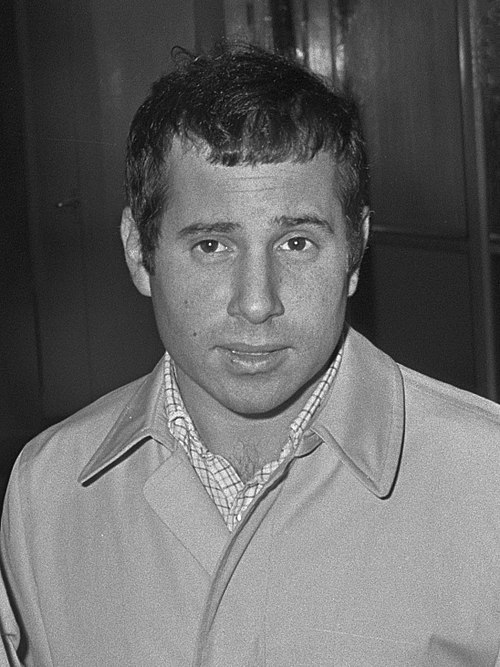
America by Simon & Garfunkel
Paul Simon later named one of his solo albums “Here Comes Rhymin’ Simon,” but there are no rhymes to be found on this masterwork, most unusual for a hit pop song in 1968. The movies have a genre called “Coming of Age,” and of course virtually all hit pop and rock records could go into a basket with that label. But this song is so poignant and evocative that it deserves a label all its own. Hitchhiking, riding the Greyhound, smoking cigarettes, reading magazines – the couple here is giddily in first love. They have become the center of all things. Life is now a movie for them to watch and comment on while scarfing down a Mrs. Wagner pie. But maybe, as the moon rises over an open field, the truth runs deeper: “Kathy, I’m lost,” the singer says, though he knew she was sleeping. “I’m empty and aching and I don’t know why.” So the kids may be out there bouncing dizzily off each other and looking for America, but what they’re really looking for is themselves. Again, not an uncommon theme, but Simon, and Garfunkel, cover it brilliantly.
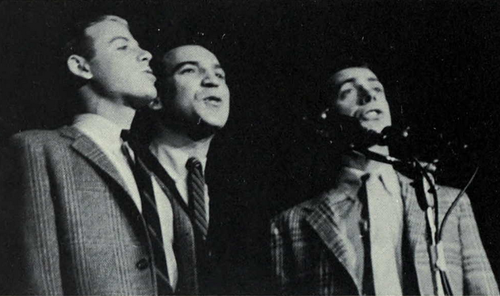
Four Strong Winds by The Chad Mitchell Trio
This is said to be the first song ever written by Ian Tyson, later of Ian & Sylvia. He claimed to have written it in 20 minutes in his manager’s New York apartment after hearing Bob Dylan play. “Four Strong Winds” feels so strong and everlasting, and it’s Canadian to its very core. The story is simple: a man in Canada, footloose and “bound for movin’ on,” has decided to head west to Alberta for work, but he kind of wants to bring someone with him who just doesn’t want to go. He’ll go anyway because for some unknown reason he has to, but he leaves with the classic born-to-be-broken promise that “I’ll look for you if I’m ever back this way.” I guess they just didn’t want each other enough. The song has been recorded countless times, most notably by Ian & Sylvia and later by Neil Young, but this is my favorite version. The singer somehow conveys the vastness of Canada, the distances to travel, the snow, the cold, the loneliness. On the darkest nights out there on the plains, if you sit still long enough this is the song you might hear on the wind.
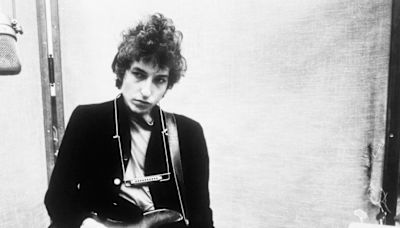
Don’t Think Twice, It’s All Right by Bob Dylan
Early Dylan has always been great for me. I guess I first heard this song when I got “The Freewheelin’ Bob Dylan” as part of a 6-for-$1.99 Columbia Record Club haul, along with albums from the likes of The New Christy Minstrels, Ferrante & Teicher and Allan Sherman, probably in 1964. “Don’t Think Twice” is riveting. It conveys the sting of an abandoned soul, someone who’s hurt and bitter and lashing out, but who still harbors feelings, and maybe even faint hope, for the one who’s sent him into the cold. It opens with a goodbye note (“When your rooster crows at the break of dawn/Look out your window and I’ll be gone”), then moves to a briefly warming thought (“But I wish there was something you would do or say/To try and make me change my mind and stay”), before moving to the extraordinary kiss-off (“You could’ve done better, but I don’t mind/You just kinda wasted my precious time”). It was unafraid and personal, very personal, in a way you just didn’t hear back in those days.
No Woman, No Cry (Live) by Bob Marley and The Wailers
I can never hear this song without thinking of “Georgie,” who would “make the fire light” in the government yard in Trenchtown. These days it’s easy to do a search to find out who he was, but for many years he was a mystery to me, and I often wondered what he thought of being called out like that in a famous Bob Marley song. (As it turns out, I don’t think he thought much about it at all.) I do wonder about all the others, though, in “Rikki Don’t Lose That Number,” “Martha My Dear,” “Maybelline,” “Judy in Disguise” and a million other songs. Are they real people or fake? If real, what do they think of it all? Lots of stories there, I’m sure. Meanwhile, the live version of “No Woman, No Cry” was recorded in 1975 before an adoring crowd at the Lyceum Theatre in London. In it, Marley tries to stem the tears of a woman, an old friend, by recalling earlier days together in Kingston and trying to paint a brighter picture of the future by repeatedly telling her, “Everything gonna be all right.” Marley could be very combative and dark in many of his songs, but he was good at sunshine too, as here and “One Love” and “Three Little Birds” (again with “Every little thing gonna be all right”). Taken down by skin cancer at 36, this was a terribly ironic refrain to find its place in multiple songs.
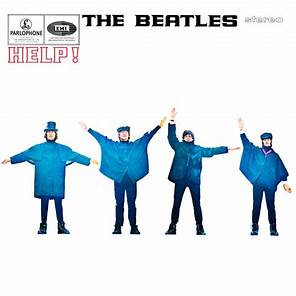
Help! by The Beatles
I often think that if I had to name my favorite Beatles album it would be the double entry of “A Hard Day’s Night” and “Help” – the British version of both. Here, the boys are just starting out, dumping the training wheels of covering American R&B classics, and seeing what they can do with their own pop-infused sound. Which was a lot, of course. They were young, too, and filled with boyish energy and charm. When “A Hard Day’s Night” was released, their ages were 21 (G), 22 (P), 23 (J) and 24 (R). It was their first album to contain all original songs, 13 of them in 30 minutes, and each perfectly capturing their spirit and talent. A year later came “Help!” with its own stunning lineup. Leading the way was the title song, an unforgettable upbeat cry for help from John Lennon (not his last cry). According to Wikipedia, Lennon was always proud of “Help!”, even once calling it his favorite. He felt it was one of his “real” songs, explaining, “The whole Beatle thing was just beyond comprehension. I was eating and drinking like a pig, and I was fat as a pig, dissatisfied with myself … later, I knew I was really crying out for help. So it was my fat Elvis period.” A cry for help and a pop masterpiece.
The Goodbye Look by Donald Fagen
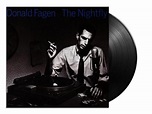
Donald Fagen’s “The Nightfly” is, after all is said and done, my favorite album. It was released in 1982 as a solo effort after Steely Dan broke up for the first time in 1981. The eight songs, impeccably performed and produced, tell stories from Fagen’s adolescence, which coincides almost exactly with my own. He was New Jersey, I was Connecticut, but we both leaned very heavily toward New York City for our entertainment, information and inspiration. He was probably more sophisticated, apparently listening to jazz radio stations while I tuned into the 50,000-watt signal of the Top 40 on WABC. I’d wager we both loved Jean Shepherd’s nightly 45 minutes on WOR-AM and maybe he joined me from afar with Chuck McCann’s Sunday funnies and Zacharly’s movie hosting on TV. Anyway, back to “The Nightfly.” Every track serves as a chapter or short story from Fagen’s formative years. I just happen to enjoy “The Goodbye Look” the most, as it very colorfully evokes what seems to be a military coup on an unnamed Caribbean island (let’s call it Cuba), and the dangers for an American who may have overstayed his visit. It’s the product of a kid who kept his ear tuned to what was going on “out there” when he was young. In that sense, I think of Fagen as Mr. East Coast and Brian Wilson as Mr. West Coast, making music from the vibe they felt as they lay in bed, eyes wide open, late, late at night.
That trip home from Mount Sinai, with John doing the driving, moving cautiously out of the city, as if I were a lopsided crate of eggs riding shotgun, took place exactly 18 months ago as I write these words. It was getting to be late fall in Connecticut, and I’d missed the annual burst of color (I’d missed summer, too, for that matter), but the other New England signatures – the rolling hills, stone walls, brisk mornings, the rich, intensely nostalgic smell of fallen oak leaves – were all once again a wonder to me. However, just because I was home again didn’t mean everything was the same as it had been. For the time being, my role would be different. I couldn’t yet do many of the things I had long been used to doing. I wasn’t yet driving, for example. Or taking out the garbage, or changing sheets on a bed, or vacuuming, or hanging a picture, or doing any number of other things that earlier had been routine, and, I hoped, soon would be again. But beyond the chores, I had changed, too. Before I’d left for my spell at Mount Sinai, I hadn’t needed a caretaker. Now I sort of did. Now I was wrapped up in myself, monitoring my every tremble and twitch. I was on daily doses of Acyclovir, Eliquis, Atovaquone, Cresemba, Losartan, Metoprolol, Pravastatin, Folic Acid and Cholecalciferol, and whatever cyclone of side effects they brought with them. At least at Hope Lodge, Marcia could come in for a week and then be relieved by someone else. Here, she was on duty every day and night, and it took some getting used to for her. Or maybe there was no getting used to it. She was there when I fell down the stairs, when I unexpectedly needed a ride to St. Mary’s for a blood transfusion, and when my shaking right hand needed help sticking a Zarxio needle into my abdomen. I not only had to be grateful, which I certainly was, I had to get out of my own head long enough to tell her I was grateful and that I understood and appreciated all she was doing. And she wasn’t the type to be shy about reminding me. Our moving forward could be awkward but it was never in doubt.
There remained the question of food and appetite as well. Coming home had not restored my desire for food. Even a traditional Thanksgiving spread, normally my favorite meal of the year, couldn’t revive my old hunger. The need to put some weight back on was getting urgent. Finally, at one of my December appointments in Manhattan with Dr. Keyzner we discussed my frustrating inability to find something I wanted to eat. She put me on a steroid called Budesonide, often prescribed for Crohn’s disease, and the effect on my appetite was immediate. It seemed to me like a miracle that I suddenly desired food of all kinds. I went on a regimen of milk shakes, whole milk, big breakfasts, bread with meals and Italian cookies, and at last my weight began to come back. Even after I was gradually weaned off Budesonide weeks later, my hunger remained and my long dormant taste for chocolate and coffee and even beer returned.
Thus, my very slow recovery continued, mostly under the watchful eye of Alla Keyzner as well as Dr. Kert Sabbath and his wonderful nurses at Leever. I only fell down the stairs twice, up the stairs once, my hair grew back and it was far softer and even less gray than it had been before, I began sneezing like Matt does (two short bursts), my hiccups subsided, my fingernails regained their normal look, my platelet count got up to the 90s, I got back behind the wheel of my car, I put my cane in storage, and my 3-hour naps got back down to a more sensible length. In short, after all these months and years, I seemed to be making it through.
“Now you’re ready for your second act,” someone said to me, and it made me think about that whole dubious trope. The “second act” has been a much-discussed concept for a long time, probably ever since F. Scott Fitzgerald scribbled in his notes for The Last Tycoon that “there are no second acts in American lives.” There appears to be some confusion about what Fitzgerald meant or what he was referring to. Was he saying that people usually don’t get a second chance at the spotlight and that creative resurrection is a myth? Or did he mean our in-a-hurry pace in America wants to take us from the theatrical first act (problem presented) to the third act (problem solved) without a contemplative, piecing-it-together act in between? It’s hard to imagine Fitzgerald intended the first interpretation since there have been and always will be thousands of examples of second, third and even fourth acts to the contrary (although Fitzgerald himself struggled mightily after his first flush of fame and died, broken, at 44).
In any case, my own second act, I gradually came to realize, wasn’t going to be something I was about to do or ever would do. Instead, it’s the story of what others had done for me. Through the long, long process of my illness and treatment, from the nightmarish lows to the ultimate triumphs, not a lot of the credit for the way it turned out could go to me. I was merely the guy on the slab, trying to stay alive. Instead, the real story was to be found in the enduring, continually called-upon love of my family; the extraordinary, sometimes surprising, warmth of friendships; the generosity of unknown blood and platelet donors; the brilliant, attentive doctors and medical staffs; and the extraordinary advances in science and scientific research that put all the rest into motion.
I think this is where I’m supposed to impart wisdom, but that’s something that doesn’t flow easily from me. The best piece of lasting advice I ever remember getting was at my 10th birthday party at a downtown Waterbury bowling alley. I was bowling well, too well I guess, when my father took me to the side and said to me, “You don’t win the prizes at your own party.” That one has stayed with me over the decades and has been useful in any number of circumstances – and I happily pass it along to you.
But sometimes the lessons you need come with perfect timing from unexpected sources. While wandering around in YouTube not long ago, I stumbled upon a version of Our Town recorded in 1989 at Lincoln Center, and something made me stop to watch it. Have you seen Our Town? You really should – or maybe see it again. It gets staged a lot, probably because it’s so spare and easy to produce, and many high school drama teachers tend to think of it as sentimental and sweet. But it’s not. It’s as hard as New Hampshire granite, and this one, with its flinty Stage Manager played by Spalding Gray and a luminous Penelope Ann Miller as Emily Webb, had me spellbound from the very beginning. I won’t recap it, but I will say it’s about living, loving, dying and simply being in a small New England town at around the turn of the 20th century. In a kind of miraculous way, it’s about nothing and also about everything. Someone in it gets to view life from beyond the grave, whereas I merely got a brief look from that general direction, but it covers much of what I would want to say at this point.
That life is fleeting and unpredictable and sometimes ends abruptly. We like to act as if this isn’t the case, but it is. We often take it for granted when that’s the last thing we should do.
That too many people go blindly from day to day, wrapped up in petty issues and dislikes, never noticing what is right in front of them – the small and simple beauties of our time here on earth.
That so many of us are too full of fear and anger and resentment and the thought that someone, somewhere, might be getting something they don’t deserve or that we’re not getting. If they could, the dead would call down to us: So what if they do?
And that a plain, simple day is a gift that we don’t value enough. This very day, this hour, this here-and-gone moment, this generous grant of life – well, it’s everything.
And right now, and forever, it’s all and everything for me.
Great taxicab rides are not usually something one associates with a visit to Manhattan, but I’ll always remember the one I took on the first day of September, 2023. Ryan, the hospital’s social worker, had come through on his longstanding promise to secure me a room at Hope Lodge, the American Cancer Society’s temporary home for cancer patients on West 32nd Street, a half-block east of Penn Station and Madison Square Garden. September 1 was a sunny and summery Friday, and my first time out of doors since June 22. My first direct sunlight since then, too. As our cab (I was with my caretaking sister Parthy) made its way down Fifth Avenue, with resplendent Central Park to our right, I opened the window and stuck my head out like a golden retriever. The warm breeze felt good on my face and bald head. The normal markers of the big city – strollers, joggers, bikers, double parkers, honking taxi horns, food carts, delivery trucks, jaywalkers, dog walkers, pigeons – were all wonderful to me, and almost more than I could bear to take in. Even stupendously crowded, superanimated Times Square was a source of delight.
Hope Lodge is but one of the American Cancer Society’s network of 30 such facilities nationwide. The first, in Charleston, S.C., was established in 1970. The guiding principle is simple: to provide accommodation, comfort and convenience at no cost to cancer patients (like me) who required frequent hospital visits but who lived too far away to commute. The Manhattan version is housed in a 12-story building occupied partly by regular tenants on the lower floors but also with 60 rooms for cancer patients on floors 7-12. We entered through an unassuming lobby and then up to the sixth floor, where the offices and public rooms are located. At first, they had us on the twelfth floor but with a single queen-sized bed, which wouldn’t do. They then placed us on the ninth floor with two single beds, a bathroom, a couple of chairs, a desk, dresser, closet and small-screen TV. The view from the windows was of 32nd Street, with its constant stream of vehicles and pedestrians and, across the street, an enormous hole in the ground where until recently the legendary Hotel Pennsylvania had stood. The hotel was to make way for a 61-floor office building, a plan that was soon delayed as market conditions for Manhattan office space deteriorated due to Covid. We were treated to the final stages of demolition, which sometimes began in the cool of pre-dawn and could be very loud. We often had to keep the windows closed. Quiet Sundays were delightful.
Each floor at Hope Lodge features its own kitchen and laundry room. In the kitchen there were designated sections in the two refrigerators and cabinets for each tenant’s food and drink, along with toaster ovens, microwaves, dishwashers, dining tables, plates, bowls and utensils. The kitchen was, in its way, yet another waiting room. It was where the denizens of Floor 9 bumped into each other, chatted, and every once in a while spilled out their hopes and fears while waiting for their English muffin to toast. It was a varied crew with varying types of cancer – a woman from upstate New York with two young children at home, a woman from San Francisco who once a week prepared a lavish dinner for everyone, couples (patient and caregiver) from Connecticut, New Jersey and Florida. Some, like me, had no hair or were bent and bowed down, or depressed, or delusional. You could see that some of them would never make it back home. The consideration, decency and good cheer – the effort – everyone showed to one another would break your heart. Of course, there were those on the floor who somehow avoided detection and clearly preferred not to mingle. Did they eat in their rooms (forbidden but tolerated)? Did they dine out? Were they never hungry? Anything was possible.
The Lodge’s sixth floor was another gathering place. The series of public spaces there included a couple of comfortable seating areas in front of large screens for TV shows or movies, a big communal kitchen used for special events (three New York Giants dropped by one day for a visit and words of encouragement, as did Martina Navratilova), a nice little library, an exercise room, and a 100-foot-long terrace overlooking 32nd Street and outfitted with comfortable seating and a profusion of plantings. Because of the tall nearby buildings, the sun never quite hit the terrace directly, but the late summer warmth and air felt good. The terrace, we soon found out, was also a home to the city’s most notorious new arrival, the Spotted Lantern Fly, described as “a plant hopper indigenous to parts of China and Vietnam.” Orders had gone out from New York agriculture officials that lantern flies were a threat to all vegetation near and far and were to be terminated with extreme prejudice on sight. So that’s what Parthy and I set out to do. It was my first attempt at freestyle exercise since leaving the hospital, and it felt good to be outdoors taking a whack or two at these surprisingly elusive pests. For her part, Parthy impressed me with the ferocity of her attack. Taken together, our tally was not large, but we felt we’d contributed to the common good.
Every couple of days I had to travel up to Mount Sinai for doctor appointments, blood draws and transfusions. There were rumors that the hospital had a shuttle that would take us back and forth, but that proved to be a heartless fallacy. I ended up depending on Lyft instead and was envious when I saw the Sloan-Kettering shuttle pull up for its handful of pampered passengers. The expense of the Lyft rides piled up – and I was shocked at how fast the rates went up when it rained – but they proved a reliable way to get where I wanted to go. The traffic through midtown was absurd in those pre-surcharge days, especially during the week or two when the UN Security Council was in session and the 10 blocks around the UN headquarters were swarming with cops and patrol cars. I will say that from my backseat perspective the early-morning doings along Madison Avenue – its galleries, specialty shops, diners, freshly hosed sidewalks, dog walking matrons – were always interesting. Up in the 80s and 90s, I especially enjoyed observing children of privilege walking to their nearby private schools, or being walked by a parent, usually a father. I gazed at these city kids with wonder. They were already well situated on the up escalator. They were not only of the big city, with attendant street smarts, but rising above it, their expensive little backpacks spilling over with future good fortune. I quietly wished them the best and hoped that one of them might someday emerge to save us all.
In any case, none of them was headed to Mount Sinai for reviving shots of blood and platelets. The time spent there quickly became routine. A blood draw, then a half-hour wait for the results. Then an assignment to a curtained cubby and bed on the fourth floor to await the infusions. The blood procedure was relatively brief, maybe a half-hour or so, but the platelets took longer. Both came to the hospital from a mysterious storage facility somewhere out in New Jersey, and sometimes there was a long wait for them to arrive. I tried to make myself the very picture of patience, mainly to make the nurses feel more empathy for me. In truth, of course, I was in no hurry. I had nowhere to go and nothing to do. The infusions would often be the highlight of my day.
The rules at Hope Lodge stated that people with certain types of cancer or who had gone through certain procedures, such as mine, required the 24/7 presence of a caregiver while living there. I felt this was a truly imposing thing to ask of family and friends, and I think Marcia did the actual asking, but many had offered to help out in any way, and so they did. They arrived in shifts over the course of the eight weeks, some for longer periods than others: sister Parthy from Charlottesville, then Marcia, then sister Susie from Ithaca, brother Michael from Culver City, Matt, old friend Mike Meserole from Waterbury, and finally Marcia again. All humbled me with their attention and care and their genuine interest in my recovery. None of them snored. They did the laundry, went food shopping, occasionally sought out a clothing item I needed (the weather was getting chilly), and had meals with me. We watched movies and games together, sat out on the terrace, and often they read or worked quietly while I napped. Later in my stay, they accompanied me on walks around the block, shielding me from screaming or sleeping homeless people as I learned how to maneuver on my cane.
My first outing onto Manhattan’s sidewalks and streets, very early in my stay, had been an adventure, a solo one. It came during a rare small gap in my caregivers’ presence; I was alone at Hope Lodge for several hours and clearly was not to be trusted. I’d discovered that my reading glasses were missing and that I must have left them in my cab or Lyft car. I didn’t have a backup pair. I knew there had to be a shopping mall of some sort inside Penn Station, a mere half-block away, and certainly a store that would have cheap readers for sale. I gazed out my sixth-floor window and considered what I’d have to do: make it down the elevator to the ground floor, get by the front-desk man, turn left out the door and head straight for 8th Avenue, cross at the light and enter the station. The major drawback was that I hadn’t walked anywhere near that distance during my hospital stay, nor had I maneuvered through crowds of pedestrians or lanes of surging traffic. Nor did I possess anything approaching my former alertness or balance. But I needed glasses.
My outing wasn’t terrible, but it wasn’t great. I tried a jaunty greeting, even a wave of the cane, with the front-desk man, who I don’t think even looked up. My walk down the 32nd Street sidewalk was probably not pretty. I felt out of place, like the first fish ever to try walking on land. But if you are cancer bald and somewhat emaciated and walking unsteadily on a stick, people, even in Manhattan, tend to give you a pretty wide berth. I made it to the broad avenue, crossed over and went into Penn Station. I noticed on a marquee that on that very night, September 7, The Eagles and Steely Dan would be appearing at the adjacent Madison Square Garden. Having seen Steely Dan 49 years earlier at Waterbury’s Palace Theater, I briefly wondered, ridiculously, if I might go. I wanted to see how one of my musical heroes, Donald Fagen, soul survivor and fellow Jean Shepherd-on-the-radio fan, was holding up. Certainly, he must be in better shape than I was. But there was no time to ponder. I was already losing steam. I found a Duane Reade drugstore, bought some eyeglasses and headed back out. On the way, I noticed a couple of figures on the sidewalk. They were bent over and holding awkward, arms-raised-behind-them poses while still managing to stand, reminding me of the Spirit of Ecstasy hood ornament on a Rolls Royce. Could they be street mimes, like the ones I remembered seeing in the courtyard of the Pompidou Center in Paris? I admired them very, very briefly but later found out that, no, they were fentanyl junkies experiencing the rigid throes of an overdose – just another dark sideshow in life’s endless carnival. I wobbled back to Hope Lodge and collapsed onto my bed. I secretly considered my excursion a victory, the first of its type I could claim in quite some time. And no one would ever have to know about it.
A great thing about Hope Lodge was that, along with my caregivers, friends could now come and comfortably see me – and a number of them did. Most brought delicious-looking baked goods, which I still couldn’t quite handle. All brought good vibes, lively conversation and, in some cases, news from home. Niece Kylie twice brought dinner from Amali, the wonderful Mediterranean restaurant she manages on East 60th Street. I was happy to see everyone and grateful for the effort they’d made, and once again I tried to read how they saw me. I had lost at least 30 or 40 pounds, my sunken cheeks gave me what a sister later called “a haunted look,” and I could only compare the very sparse growth on the top of my head to Popeye’s. But people didn’t seem to mind. They didn’t stare. Their job was to make me feel better, and they did. Meanwhile, the days went by. The U.S. Tennis Open and the Ryder Cup came and went, baseball moved into playoff mode, the college and NFL football seasons began, even pro hockey and basketball started up. I had begun to think of Hope Lodge as a place everyone “hoped” to leave both standing up and before too long.
But the truth was that my blood numbers were still not improving by much, certainly not enough to allow for my release. As the calendar turned to October, Dr. Keyzner came to the conclusion (one that she’d apparently been mulling for quite a while) that I should have a “boost” for my stem cells, meaning another infusion from Matt. The problem was that my engraftment process had been generally sluggish, and it was taking too long to produce new blood cells. An additional boost might lead to improved blood cell production and a faster recovery. It was a step I hadn’t realized Matt might have to take, but he did it without hesitation, and this time I got to visit him as he lay for hours on his hospital bed, sending his cells into a little collection shag bag.
The process for me was nothing like the first time. There was no killing me first, no chemo blasts, no nightmares, no morphine, no hallucinations – just a simple transfer of the cells from Matt to the container to me. I didn’t even have to stay overnight in the hospital. And as October progressed, I thought I might be feeling a little bit better every day. Everyone began to understand that, at this point, a sort of uneven recovery had arrived, and I’d be better off at home, or at least no great harm would come from my being there. My blood counts were by now moderately, rather than gravely, poor. My recollection is that my platelets were around 60 and trending slightly upward (again, normal would be 150-450). Hemoglobin was rather low but white blood was near normal. If it came to getting blood draws and occasional transfusions, I could do that at home, at Leever Cancer Center or St. Mary’s. If it came to napping for hours, I could do that at home. If it came to not eating, I could do that at home. If it came to losing my cellphone or balancing backward against a wall in order to put my pants on, I could certainly do that at home. I felt ready for the challenge, to see what was going to happen. With the boost, Mount Sinai had really done all it could do for me. Doctor Keyzner and I spoke, along with Marcia. The good doctor agreed. She thought that with a local oncologist watching over me and communicating with her, and a schedule for in-person follow-ups, it was finally time to get back to Connecticut. We set the date for October 31, 2023.
“A heavy blow takes you to the door of this room. It opens, and you see neon, orange and green lights blinking. You see bats blowing trumpets, alligators playing trombones, and snakes are screaming.”
– Muhammad Ali
It is here that I begin to lose track of things. I do know that I was in the hospital for exactly 70 days. I remember that at first the days of heavy dosing with three different types of chemo went easily and well. Even as the poisons were wiping out millions of my blood cells, cleansing me and, like obliging angels, bringing me right out to the edge, I began to think that maybe this whole procedure – killing me first – might not be so agonizing after all. Maybe I’d somehow be able to defy the odds, nimbly skip the hard parts without much trouble and live happily ever after. Then Dr. Keyzner, in one of her prep talks, told me to please beware. These few days might be fine, she advised, and the day of rest, too, and even the first day or two following the transplant. But then, she indicated, it would be game on, the honeymoon would be over, and I’d know I was engaged in a battle royale. Maybe she was right, but these early days did go by smoothly. I ate well. I had visitors. I familiarized myself with my surroundings. I tried to figure out how the TV worked and why the hospital wi-fi seemed to disconnect after 30 seconds of disuse. I went through whatever preliminaries the staff set before me. I began to chit-chat with some of the nurses and orderlies. I wanted to make friends for the rough days ahead.
The actual transplantation of Matt’s stem cells into my bloodstream on June 27 was so low-key that I don’t remember it at all. I’d earlier had a port installed in the upper left side of my chest by a madcap doc whose good humor I found infectious. After a few moments of probing, he showed me a tiny red plastic heart. “I found it!” he exclaimed, laughing, holding it between his thumb and index finger. “Oooookay,” I thought to myself. “I’m in the funhouse now.” But the transfer of cells through that port a couple of days later occurred without humor, as I recall, and seemed terribly anticlimactic following all the months and even years of build-up. I returned to my room to await the eventual graft versus host showdown – the invariably awkward introduction of Matt’s cells into my environment. Would everyone get along or would there be trouble? It was far from unheard of for the process to turn fatal right out of the gate. And then there were the large amounts of chemo introduced into my system, three kinds, each with its own set of house-of-horrors side effects. When would that truly begin to kick in?
Soon, as it turned out. After a couple of days, a rough sort of disorientation began to set in, and then all of a sudden it overwhelmed me. I lost my grip on where I was and what was going on. I lost my sense of time and even whether it was day or night outside. For a while – days – I went very deeply into places I’d never been before. My nightmares were astonishingly vivid. In the one that I remember most clearly, I was on one of the top floors of the World Trade Center when the planes hit. It soon became clear that I’d have to jump in order to have control over my own way of dying. I jumped and dropped through a ring of smoke and flame. I reached out and scraped my fingers along the side of the building as I plummeted down. I hit the ground and then there was nothing but blackness and silence. Meanwhile, I was in actual pain, too, although I don’t remember where or what kind of pain it was. It must have been bad though. They gave me a morphine button, and every once in a while I was able to treat myself to a hit. As the drug entered my system, I felt a reassuring pressure, like the pressing of a thumb, above my right eye on my forehead. I took all the morphine I could.
I experienced hallucinations that could take me out of my hospital bed and put me in better, or at least different, places. My favorite was a spot alongside a lazily winding Southern river, with Spanish moss hanging overhead. It was a serene setting with filtered sunlight and the sound of water running across stones. I went there more than once. One time, I saw some people off in the distance on the opposite riverbank and then realized they were one of my doctors and his associates stopping by for a visit. Another hallucination took me to the tap room of a New England country inn, where I sat quietly and watched as people – vacationers, it appeared – came and went, some carrying skis, and a nice fire crackled in the hearth. My last escape was an especially weird one, a two-story brick building located in Wallingford, Connecticut, seemingly a rehab facility of some sort. I was aware that to the rear of the building was a large swimming pool designed to look like a Roman bath. I was on the building’s front lawn one night when I was overcome with an explosive surge of diarrhea. I was helpless to stop it or control it, but luckily two nurses came out (had they been watching me from a rehab window?) and got me fixed up again – although one of them kept saying, “Bad boy, bad boy.”
Non-hallucinations could be no less extraordinary. Most notable of all was the night when I sat on the edge of my hospital bed and it gradually dawned on me that my hair was falling out. I slouched dejectedly in the room’s half-light and methodically began pulling out sad little clumps, letting them flutter to the floor. When the morning came, my full head of gray and black hair, always haylike and difficult, had been replaced by no hair at all. My eyes kept playing tricks on me, too. I could close them and see kaleidoscopic patterns in various colors and configurations, and if I shut them tight I could achieve total blackness even in the middle of the day. My favorite pattern, which continued on and off for quite a while, was a checkerboard of tiny black and green squares.
Meanwhile, the chemo kickbacks were easy to spot. The predicted mouth sores brought an elemental, even Old Testament, misery. The pain was difficult to manage. I couldn’t chew or swallow. I had to ask the nurses to chop up some of my larger pills and mix them with applesauce so that I might be able to slip it all down my throat like the way you fool a dog into taking distemper pills. As for food, I’d completely lost my appetite. Nothing was appealing and wouldn’t be for months. I tried to think of things I might be able to tolerate – an orange, some yogurt, a Hostess fruit pie – but all proved to be more than I could do. All liquids, even water, were unappealing, too. I was perfectly happy to let my feeding and hydrating IV tubes do the heavy lifting for the time being.
I scraped bottom for about 10 days. This is when people thought I might not make it. I lay in bed and slept a lot. Marcia and the kids came to visit, but I was barely aware of their presence or would simply nod off in the middle of a conversation. Or maybe I’d pull out my plastic container and take an ill-concealed leak while they were talking. One visitor I remember was the staff person who came by to give me a cognitive test as a way to measure my recovery and where my brain stood. It was the same sort of test Donald Trump claimed to have “aced” by successfully regurgitating the words “Person. Woman. Man. Camera. TV.” in proper order. I wasn’t so successful, at least the first time I was tested. She asked me who was President and I couldn’t remember Joe Biden’s name. She asked me what day it was, a standard question, and I couldn’t tell her it was July 4th. She asked me to spell “world,” which I did, and then she asked me to spell it backwards, which I simply could not do despite a number of tries. The woman told me not to worry, that my answers would improve over time, but of course I did worry. And when I finally remembered the President’s name a little while later, like a candidate-besotted campaign worker I shouted “Joe Biden!” into my empty room.
Nurses and other staff broke through the hospital fog with regularity. There were so many different nurses, and personalities and levels of competence (most were highly competent) that it was hard for me to establish favorites. I did think that one nurse with black-framed glasses was wonderfully adept, sharp and friendly, but she soon moved off to other things and I never even caught her name. I missed her when she was gone, like someone you fall in love with on a train, but it’s probably not a great idea to try to establish friendships in the stem-cell replacement ward. There was an African orderly named Joseph who impressed me with his air of peace and serenity. Never have I seen anyone change the sheets on a bed with such methodical purpose and perfection. I was heartened to see him at work. The others did what they had to do, usually with good cheer. They brought me my pills, adjusted my bedding, helped me to the toilet, kept my array of IV units in order, took my vitals (blood pressure, temp, oxygen level) with exhausting frequency, brought my meals (which I never ate) and kept my pitcher of ice water fresh (but not tempting). There were also those who drew my blood multiple times every day. They stuck a needle in my arm, or wrist, or even my hand as my veins, as with an old tin mine, became thin, dusty and unproductive. Getting the first blood draw of the day turned out to be my daily wake-up call. Someone would come in around 5 a.m. to stab me and draw out one or more vials of fluid. The doctors would want to see my new numbers first thing when they came in to work. At one point along the way, my veins became so depleted that they brought in a specialist, a sort of “vein whisperer,” to find and open up a new line. As he worked (successfully, as it turned out), I thought he carried himself with the stealth and quiet self-importance of a safecracker.
Doctors came by several times a day. Doctor Keyzner was not among those making the rounds at the hospital while I was there, although she did drop by from time to time. The doctors I saw all had bone marrow transplantation as one of their specialties. Their bedside manners varied greatly, running from gruff to harried to nicely engaged and informative. One seersucker-clad older doc and I, and my brother Michael, who was visiting from California, had a quite detailed chat about root beer. Another, whom I saw a number of times, was John Levine. He was full of good energy and gave me just the sort of attention I needed. He usually arrived with a coterie of younger associates, I guess med school students, so I tried to play to the crowd as I described my latest woes and symptoms. But the one I will remember most fondly was Aaron Etra. Each morning, after my 5 o’clock jab, I’d lie in sort of a suspended twilit state, unable to go back to sleep, and then, after a while, I’d be aware that someone was standing at the foot of the bed – Doctor Etra, coming to say good morning and see how the night had gone. He was always a welcome sight, even when I didn’t feel well. He struck me as calm and meticulous in word and deed. He was also very low-key funny. Those in my family who spoke with him found him to be extraordinarily well-informed and helpful. He always had my blood numbers at the ready if I wanted to hear them and answers to my many questions. He was concerned with my lack of appetite. “If I bring you a Hershey Bar will you eat it,” he asked. “Yes,” I lied. He brought it and I couldn’t eat it. I couldn’t even look at the package. After maybe a few weeks, he drifted off to another assignment and I don’t think I saw him again. Another train-ride fling.
I stayed in my little room all of July and August. I was in Manhattan but it could have been Manhattan, Kansas, for all I knew or cared. My view out my window was unchanging: people walking back and forth in the corridor across the atrium, sometimes with a sense of purpose, sometimes not, sometimes with a cup of coffee in hand, sometimes not. Their endless, silent milling reminded me of figures in a Fellini movie or the milling pedestrian crowds in Rome at dusk. I was reduced to watching Yankees games on TV. I had no energy for reading, and often little interest in talking or even scrolling on my phone, which always seemed just out of reach or needing a charge. I could sit up in bed and even rise and get to the bathroom with the help of a walker, dragging my IV array behind me. It was a tedious process, first to ring for help, and then for help to arrive, and then for me to stand, untangle my attachments and get moving. I didn’t always make it in time, especially in the early days. But things got better as I regained some control over my various interior systems.
Marcia called every morning at around 7:30 to get my blood numbers and see how I was doing. She was gradually getting used to being alone in the house and taking care of things I normally would do. One morning she woke up to water in the basement and learned that the hot-water tank had burst. She managed the purchase and installation of a deluxe new tank. Very deluxe. She also had a stand-off with our duplex neighbors, with whom we shared an outdoor deck space separated by a wooden divider. They were redoing their side and, as I understood it, proposed a change in the configuration in which they’d gain some of our existing space. Marcia did not let that happen. She described the situation to me over the phone but I was in no shape to get involved. Overall, I think she enjoyed and was proud of how she’d handled her trial run of widowhood. She was comfortable with her single status, felt secure in our house, counted on her large and loyal group of female friends for support (as she’d provided them on many occasions), and could dine happily and guiltlessly on broccoli cooked, broccoli raw, her own home-baked cookies and an occasional piece of salmon.
She also came to visit me, as did John, Matt and Claire. Their presence always lifted me out of my semi-conscious state. John brought news of their new addition, Charlie, who’d been born in May, not long before I’d gone into the hospital. I’d visited him briefly at the time, thoroughly approved of his name and now was happy to hear that all was well with him and that his 3-year-old older sister was treating him with love and care and only an occasional too hardish squeeze. Claire brought photos of James, who was developing a passion for trucks. She also broke the huge news that she was expecting child number two, due in April. Things move fast if you turn your head for just a second. Matt no doubt wanted to take a close look at me to make sure his stem cells were still on the job.
Also arriving on the scene was my dear brother Michael, flying in from Culver City to enter my room with suitcase in hand and his guitar on his back. He’d be able to stay at his daughter Kylie’s place in the city and spend lots of time with me. Michael is 18 months younger than I, open-handed and outgoing, a lifelong fellow traveler and a talented singer, musician and songwriter. We had so much we could talk about and, even with me in a woozy state, laugh about. I still wasn’t eating or drinking anything and we thought that ice-cold soda might be the answer. He scoured the neighborhood and came back with some premier bottles – Boylan’s root beer and orange soda, Stewart’s birch beer. But when the time came, I still couldn’t face drinking them. I did like the idea of drinking them though. We talked a lot about music, too, as we always have. I revealed to him that should I require a memorial service anytime soon, I’d love it if he could close out the ceremony by singing the old Kinks song “Days,” with whatever audience participation he could muster. He wanted me to compile a list of my favorite 20 songs, but my handwriting was so weak and shaky I finally gave up writing the names down. Sandy Denny’s “Who Knows Where the Time Goes?,” Paul Simon’s “The Only Living Boy in New York,” the Rolling Stones’ “Paint It Black,” Tracy Chapman’s “Fast Car” and Procol Harum’s “Whiter Shade of Pale” were among the many songs, none of them remotely recent, that we discussed, or played, or sang. Of course, I was apt to nod off in the middle of an incisive critique, but I think he nodded off a few times himself.
All the while, my main objective was to get my blood counts back into a normal, or normal enough, range. I wouldn’t be discharged until that happened. The normal range for platelets, for instance, is 150-450. Post procedure, mine were at 6, and it was a battle to get them above 10 and then 20. From the very beginning, Dr. Keyzner and the others had advised patience above all else, and we tried our best. But it wasn’t always easy, or even possible. My red cells and hemoglobin were also lagging. To stabilize them, I needed many blood and platelets transfusions. I will always be grateful to those, unknown to me, who donated and helped keep me alive.
Eventually, very gradually, my numbers began to improve, and it came time to leave my hospital bed. When the day arrived at last, I was happy to put on street clothes and actual shoes. To help me move about I had a borrowed cane and a walker the hospital kind of forced on me, and which I never used. (It remains in pristine, unopened condition in our basement at home.) I thought I might be able to use a wonderful old cane my father had held onto from his days in Sphinx, a “secret society” at Dartmouth, circa 1933. But I needed more than a decorative old stick for support. Just before I left, the discharge nurse came in with her list of do’s and don’ts and a shopping bag full of drugs and related paraphernalia. I wished there’d been a chance to properly thank and say goodbye to everyone who’d hung with me for 10 weeks. It was hard for me to square what had meant so much – everything – to me, the annihilation of my deadly diseases, with what was mere routine for them. I still had a great deal of recovering to do – my stamina and balance were poor, my appetite was nonexistent, my pallor was notable, my head was hairless, my hiccups persisted. But I was delighted to be wheeled out Mount Sinai’s front door and into the open air.
In October 1958, at the Boris Kidrich Institute in Vinca, Yugoslavia, there was an accident involving a nuclear reactor. The reactor, in use for research purposes, malfunctioned and released radiation into the lab’s interior spaces. Six workers received potentially lethal doses. All developed severe radiation sickness and one of them died right away. The other five unwittingly took part in a medical marvel. They received experimental allogeneic bone marrow transplants, the first ever in humans. The transplants eventually were rejected by all the patients, so little was known about blood and cell compatibility. But it was thought that before rejection the infusion of donor marrow probably contributed to the men’s initial survival.
Rushing to the scene to conduct the transplants had been a French oncologist named Georges Mathe. He and others had been working on transplants, usually with mice, for some time, with promising results. But they’d been reluctant to try it on human beings. Now, with Mathe’s relentless pushing, they’d just gone ahead and done it. In certain, major ways the work had been successful, but it still seemed like an experiment. It had a back-to-the-drawing board feel to it. Doctor Mathe did go back to work, almost obsessively, and in 1963 he shocked the medical establishment again by announcing he’d cured a patient of leukemia via a bone marrow transplant. Again, the patient didn’t survive for long, but it wasn’t the leukemia that killed him, it again was complications from the procedure. After that, work on thousands of refinements started up around the world, but Dr. Mathe had set the bar. “It was quite a leap of scientific genius,” said Dr. Joseph H. Antin, chief of stem-cell transplantation at Boston’s Dana-Farber Cancer Institute. “He’s one of the original innovators. Much of what we’ve accomplished can be linked back in a fairly direct way to the work he did in the 1950s and ‘60s.”
At around the time of Dr. Mathe’s leukemia announcement, a couple of Canadian researchers, Drs. James Till and Ernest McCulloch, stumbled upon a discovery that would soon make all the difference in the transplant world. While delving into the many mysteries of bone marrow they’d turned up a cache of something they hadn’t noticed before: self-renewing cells – stem cells, as they’d eventually be called. Further, they discovered that these cells had the ability not only to grow, but to take on the characteristics of whatever type of blood cells the body needed – white (help the body fight infection), red (carry oxygen through the body) or platelets (help blood clot and prevent bleeding). Researchers realized that if they could inject the cells into a failing vessel, they might propagate and bring new life and strength, and not just for cancer patients but possibly for other illnesses as well. Now other labs around the world joined in the effort. One major finding came early on. It became clear that, once they were injected, the new stem cells often went fatally to war with whatever host cells they encountered. Researchers realized that in order for the new cells to have a chance do their job, the old cells would first have to be removed. The good news was that advances in chemotherapy and radiation were making that increasingly possible. In my case, several days of intense chemo would wipe out both my cancerous and noncancerous cells (kill me) and then an injection of Matt’s healthy, younger cells would bring me back to life.
As to Matt’s role, other advances over the years had made the donor’s job reasonably simple and painless. Instead of undergoing the arduous physical removal of marrow from his hip bone, he’d lie on a hospital bed as a catheter in one arm removed blood, sent it to a machine that extracted the stem cells (I always picture a coffee filter doing the separating), and then returned it via a feed to his other arm. It would take four or five hours to collect enough stem cells. They’d be bagged, tagged and, in a day or two, injected into my own bloodstream, where they’d migrate to my marrow and replace the cells that had been burned away by chemo. At least that was the plan. Lots of problems might pop up, especially among the millions of adjustments following the procedure, but the road into Mount Sinai’s operating theater had become clear, straight and well-lit. No turning back. June 27 was the day.
Following Connecticut’s long winters and stubborn springs, June can sometimes seem like it will never arrive. But in 2023 it arrived way too soon for my taste. It came in at a gallop. I by now had little to do but wait as the days tumbled forward. My continuing neutropenic state kept me from any “Connecticut Icons” speaking engagements. I’d withdrawn from my golf league, leaving my partner with the task of finding a new mate. I couldn’t summon the focus or the creative energy to work on any writing projects. My calendar showed nothing other than doctor appointments and a few birthdays and anniversaries. Doctor Keyzner had not seemed terribly fazed by my stay in St. Mary’s. There’d been no lingering effects or notable weakening in my systems. Just to be sure, she put me through all the preliminaries: EKG, echocardiogram, CT scan, liver and kidney exams, a pulmonary function test, an assessment of my veins, and blood draws of every stripe. All was “go,” as they used to say leading up to NASA space launches. I was ready to get locked into the capsule.
We didn’t have any kind of send-off. We didn’t really have too much of an idea of how long I’d be gone. I’d always been in charge of paying the bills and minding our family financials, but by now most of the major bills were taken care of with auto-pay and our financials were in the capable hands of Marcia’s brother, Dave, a longtime broker and financial advisor. Even so, I went over everything with Marcia and John, warned them we’d soon be getting our property tax bill in the mail, and asked that my car be taken out for a run every now and then. There was also the question of our July beach rental in Rhode Island. As I indicated earlier, Quonnie had for years been a place of peace and relaxation for all, but especially for our children. They’d enjoyed its sea breezes, sandy bike paths, crabbing expeditions and weekend morning softball games for as long as they could remember. Even now, they liked to entertain each other with tales from Quonnie’s timeless summer story and their own indelible places in it. We months earlier had reserved our place for four weeks, beginning the last Saturday in June. Soon after, I realized I wouldn’t be able to do it and then I learned that no one else in the family wanted to, either, if I was going to be in a hospital room somewhere. At first we thought the last two weeks of July might be a possibility but then decided the last two weeks of September could work. Luckily, we’d rented the same place for several summers in a row and had built a relationship of sorts with the owners. They hung with us through all our changes, as did the rental agent, and for that we will always be grateful. My own take was that if I could get to the beach, by medivac if necessary, even for a single day, I’d be delighted. But delight would not be on the menu that summer.
Marcia and I went down to Manhattan a day early and stayed overnight in our friends’ unoccupied apartment just off Madison Avenue on East 67th Street. We strolled over to an Italian restaurant on Lex, where we dined in one of those ubiquitous sidewalk enclosures. Dining at the table next to ours was a person in a full Spiderman costume who, as far as I could tell, never went out of character. We tried not to be solemn about the occasion, but the “last meal” or at least “last good meal” aspect was hard to avoid. The plan was to go up to Mount Sinai the next day for admission and a battery of meetings with the admitting nurse, the social worker, the physical therapy worker, the drug person, and so forth, all of which we did. At some point, Marcia left for home and I changed into my hospital gown. Also at some point, when I was out of my room, someone entered and lifted my pair of AirPods, brand new and never worn, a “going away” gift from a dear friend that I was stupid enough to leave on the bedside table. Not a great start to my visit, although it taught a valuable lesson about pocketable valuables in a place where many different people entered and exited many times a day. I think we did manage to trace them to New Brunswick, N.J., but that’s where the trail went cold.
I don’t know if I ever learned what floor I was on, but it was another Neutropenia Suite for one, with bathroom, TV, comfortable chair and even a view of a sliver of Central Park, shockingly green and inviting against the neutral colors of the hospital exteriors. It was even possible to see the softball diamonds where Matt played some of his city games. The building was the Guggenheim Pavilion, designed by I.M. Pei and opened in 1992. The New York Times had greeted the new building with lavish praise (I did notice the name of Times publisher A. O. Sulzberger on the hospital’s roster of board members). “I.M. Pei continues his quest for a clean, well-lighted place,” the Times’ report began. “This time, the search has turned up a couple of beauties: a pair of lofty atriums, luminous with natural light. Rising 6 and 11 stories, respectively, these radiant, three-sided rooms offer Mount Sinai’s patients one of the world’s oldest holistic therapies: architecture.” But wait, there’s more: “Mr. Pei has created a modern building that looks nothing like a hospital, even though it is one. It resembles, rather, a health spa, a tranquil oasis where trees grow and space soars amid urban bustle and big-city hospital commotion. [It’s] a building of uncommon clarity in more than one sense: lucid in organization, lustrous in space.” Well then. Would it be churlish of me to say that the brilliance of the triangles never occurred to me, nor did I ever say to myself, “Hey, wait a minute, am I in a hospital or a health spa?” I saw it instead as a handsomely designed hospital, on the new side, well equipped, with public spaces I was unfortunately never able to visit. I guess the gulf between a patient’s view and that of a newspaper’s architecture critic can be wide.
One thing I did notice and come to greatly appreciate during my long term at Mount Sinai was the roster of names displayed on the walls of the hospital’s many buildings and halls – Guggenheim, Hess, Icahn, Klingerstein, Kravis, Rubin, Annenberg and all the rest. Were they robber barons and thieves? I don’t know, maybe, but they’d been big givers in a world where big giving was needed. Of course there’d been thousands of little givers, too, and all could be rightfully proud of what they’d helped create. But the big guys, the pharaohs, kept Mount Sinai at the head of the class when that meant raising $500 million for a building project. The longer I stayed, the more I was thankful for their largesse.
As that first night fell, I had no choice but to contemplate what lay ahead. All else, all those months and years, had been mere prologue. The moment had finally arrived. I would undergo three days of powerful chemo infusions, have a day of rest, and then receive my new stem cells. At some point during this period, Matt would be in a bed in another part of the hospital having his cells extracted. I’d had a chance to speak with him a few days earlier. He of course feared that his cells would not be enough to do the job and somehow would lead to my demise. He wondered if he was really the right one for the job. I begged him not to worry, and that if anything went wrong it was the fault of the patient (me) and not him. “If the procedure is a success, you’re a hero,” I said to him. “And if it’s not a success, you’re still a hero.” I thought of that conversation as I drifted off in my narrow hospital bed that night of June 22, the first of 100 straight nights of sleeping flat on my back.
As the 19th century rolled into the 20th, Waterbury, with its belching factories, especially those devoted to brass, was growing at a frenetic pace. As it grew, it added new schools, churches, retailers, banks and housing to its list of local assets. It built roads, parks and a visionary water-supply system. Eighty-six passenger and freight trains moved in and out of the city each day, so a suitably grand railroad station (modeled after a tower in Siena, Italy) was provided by the New York, New Haven and Hartford Railroad. Theaters? Check. Hotels? Check. Museum/historical society? Check. Fraternal organizations? Too many to name.
Among all these moving parts, one essential institution in particular seemed to need a lift. What was to become Waterbury Hospital had begun service informally in the years following the Civil War, situated in a series of wooden structures, more like houses, actually, on the west side of the Naugatuck River. In 1890, the organization was formalized in a proper hospital building further up what is known today as West Side Hill. It was a modern facility in every sense, but after only a few years it was clearly not fulfilling all the needs of the burgeoning community, especially those of the waves of immigrants moving in from Ireland, Italy, Germany, Poland, Lithuania and the Southern states of the U.S. More hospital beds were needed, and the Catholic Church, then very much in the ascendency, rose to the task. St. Mary’s Hospital, founded by the Sisters of Saint Joseph of Chambery, opened its doors in 1907.
Doctors who happened to be Catholic and of other non-Protestant faiths, were excited about the new facility. At Waterbury Hospital, they’d had a tough time consulting with, advancing among or even socializing with, the WASPy medical establishment there. They wanted and needed a place of their own. That’s why you see my grandfather’s name, Charles A. Monagan, Obstetrician, on the plaque listing St. Mary’s founding doctors by the hospital’s main entrance. As the century progressed, Charles’ son and my uncle and godfather Thomas M. Monagan, a much-loved pediatrician, began his decades-long affiliation with St. Mary’s. In 1950, I was born there, followed in due course by my four siblings, not to mention 17 Monagan and Murphy cousins. So that’s why on the morning of March 22, 2023, when I woke up at home with a fever and a general feeling of malaise, Marcia quickly gathered me up and we headed straight for the St. Mary’s emergency room. It was hard not to believe that my neutropenic state was about to be tested, and we knew that time would be of the essence.
What happened during my week-long hospital stay was more or less a flirtation with death, or at least a rehearsal of what was to come a few months later. As we made our way to the ER, Marcia phoned our friend Dr. Paul Kelly, soon to become my cardiologist, to advise him of our situation. Doctor Kelly immediately contacted the hospital and told them a neutropenic basket case was headed in their direction and to please allow him to pass through the coughing, sneezing, wheezing, contagious, feverish waiting room as quickly as possible. This they did, but of course my infection was already well established. The hospital’s job – the doctors’ and nurses’ job – would be to contain what I had and keep the grim reaper from rolling out the black carpet.
I was put into an ER bed, isolated from other patients. My temperature upon arrival was 102.4 degrees, already up from what it had been at home. A doctor sized me up and asked a lot of questions. He learned of my two cancers, my bout with chemo and my planned stem-cell procedure, now a mere three months away. Blood was drawn. Tests were taken. The verdict, delivered that afternoon, was neutropenic fever and a presumptive diagnosis of sepsis. Sepsis. I’d heard only terrible things about sepsis, of how quickly and permanently it could turn a body into a junkyard. They said they needed to admit me and get me into a bed upstairs.
Even with a dire diagnosis and a raging fever soon to reach 104 degrees, I kind of enjoyed being wheeled through the hospital corridors and up to my room. I’d never been admitted to a hospital before, and I wanted to appreciate all the angles and views. It was like my one ride in an ambulance years earlier (for nothing, as it turned out). I was determined to take it all in and enjoy it. I dared the orderly to go faster. Of course he didn’t, but I think he wanted to. We got to my room, a single, my Neutropenia Suite, and I was heaved from the gurney into the bed. And that’s when I really began to feel sick. I would stay six nights at St. Mary’s. Along the way, I’d be on oxygen a fair amount of the time and diagnosed with parainfluenza pneumonia, febrile neutropenia (sounds more impressive than neutropenic fever?), acute hypoxic respiratory failure and elevated heart rate/atrial flutter. On one of the early nights, I’m not sure which, I tried to rise out of my bed and pulled out some of my IV hook-ups and then fell back across the bed and I think damaged the port that had been installed for my chemo infusions. It was an awkward sequence to say the least. I could only compare it to the poor guy going off the side of the ski jump in the old “Wide World of Sports” intro. I don’t know where I thought I was going, but the nurses were not happy. I stayed put after that.
Even for someone in my vulnerable condition, the hospital allowed visitors, but only one at a time. Marcia was of course a steady, encouraging presence, my self-appointed advocate, unafraid to question the authorities and push things on my behalf. But here came my children, too! Did they think it was again time, 13 years later, to say goodbye? Possibly, but they were, at least in my presence, nothing other than encouraging and cheerful. They arrived in birth order. First came John, 37, bright and early one morning, responsibly, even eagerly, assuming the mantle of the eldest, both with me and his mother. He’d been a little disappointed not to have been chosen as my donor, I think, but he saw it as his job to help out and keep the home fires tended in my absence. He brought something to eat, probably doughnuts, and we no doubt marveled at the UConn men’s basketball team’s continuing dismantling of the opposition in the ongoing NCAA Tournament. Then Matt, 36, appeared out of nowhere, as he so often does. He wasn’t there and then there he was, standing at the foot of my bed, freshly arrived from Greenpoint. His job as an editor and writer at Major League Baseball was ramping up with the start of the new season only 10 or so days away, but he hung with me even as nurses and doctors came and went. Sadly, he was well versed in hospital procedures and priorities, and he knew well that simply being present counted for a lot. Claire, 33, made the trip from Brooklyn, too, taking the day off from her 7-month-old. Among my visitors at St. Mary’s, and certainly later at Mount Sinai, Claire was the closest to being our own family doctor. When she’d entered college 15 years earlier, she thought she might like to be a doctor and started down the pre-med path, only to be so shaken by an early B in, I think, a Biology course, that she abandoned her plan and took a different route instead. (Successfully, as it turned out; she ended up a Rufus Choate Scholar, meaning she ranked in the top 5% of her Dartmouth class.) But now you could see the would-be medico re-emerging. She was better versed about the material in my patient portal than I was, and she was willing to ask questions of the doctors and nurses until she truly understood whatever it was she needed to know. She knew how to study, always, and as she studied me lying there in my Neutropenia Suite I don’t think she missed much.
Once they got my fever down, I recovered rather quickly, or at least felt a lot better. Heart issues did not return. After six nights, we broke camp and headed back to our routines. I didn’t suffer any setbacks and continued to improve every day. I don’t remember the food, so it probably wasn’t terrible (or maybe there wasn’t any). I was grateful to St. Mary’s for its quick, serious attention to my condition and for supplying me with all I needed to get home again. I felt I was in good hands throughout. And while I lay in that bed, looking out at the westbound traffic on I-84, I thought often of my own father’s brush with death at St. Mary’s back in the summer of 1941. He was 29 and single, a young lawyer and president of Waterbury’s Board of Aldermen. He’d gone into surgery for what the doctors thought to be appendicitis, but once they were in, they came across a growth on his intestine and, without hesitation or consent, removed that as well. It was a major undertaking and the methods and tools were terribly crude by today’s standards. He labored for days in a delirious state, hallucinating things like his own doctor chasing him around the hospital roof. As he slowly recovered, the United States entered the war against Germany and Japan, but he was not in enlistable or draftable condition, which greatly frustrated him. He ended up settling for being mayor of a major industrial city with a booming wartime economy (1943-48), hosting war bond rallies, seeing troops off at the railroad station, equalizing pay for male and female city teachers, integrating the police department and establishing civil service guidelines for hiring and promotion rather than keeping complete power over both within the mayor’s office. In later years, he spoke fondly of St. Mary’s, its doctors (many of whom had known and worked alongside his father), its no-nonsense nuns and nurses, and its daily room-to-room Holy Communion, including the enforced fasting for recipients of the host, even those quite ill patients who might have benefitted from a bite or drink of water.
As for my family, my stay at St. Mary’s was like spring training for the campaign to come. Asked to respond quickly to an unforeseen crisis, they did so. They rallied, radiating love, concern and the wish to help out. Their commitment to me was heartening. I wondered how many more times I’d have to call upon them.
With three months to go before the big day, I began to contemplate my odds, my fate and my mortality. At 73, I’d already lived what many would consider to be a full life (at last look, the average last birthday for American males was No. 77). I was showing unmistakable signs of my “aged” status, too. For instance, as an over-70 male, I still looked up whenever an airplane passed overhead. I could remember my childhood phone number as Plaza 4-0951, as well as air raid sirens being tested on Saturdays, a Conelrad triangle on my radio dial, and life with a black-and-white television that could only get one channel (Channel 8 from New Haven). I could recall hearing and repeating the WWII child’s sidewalk taunt: “Whistle while you work/Hitler is a jerk/Mussolini broke his weenie/Now it doesn’t work.” I’d developed a tremor in my right hand that had made it sometimes difficult to tee up a golf ball. I remained wary of microwave ovens. My grasp of proper nouns was fading: I’d be able to remember that actor’s name if only I could remember the actress he played with and the name of the movie they starred in. My nighttime driving wasn’t as cooly confident as it once was. I didn’t mean to pour orange juice onto my cereal. Sometimes I felt I was only a short step away from getting back to that online Nigerian chap to ask about his enormous bequest to me.
If I’d been 43 or even 53, I’m sure I would have been bitter and angry and probably depressed about my fate. Instead, as the weeks went by, I became rather businesslike about things. I created a computer folder containing various financial notes, passwords, a copy of my last resume, a few Far Side cartoons and, most notably I guess, my obituary. I considered the obit important because it was a last chance to tell my own story (at least before I got the idea of writing this memoir) and lay out some of the things I thought were important in my life. Many people have the time to do this but never do. My mother kept copious, well ordered notes and records of her time on earth but never went so far as to pen an obit or even an outline for one. My father, on the other hand, started his obituary decades before he died, adding to it, subtracting from it, curating it with an undertaker’s acute attention to detail. As it turned out, it was a good read, and a lasting record of what he thought important about his life, but too long and detailed for publication in the newspaper. Luckily, after he wrote the obit he still had plenty of time to compile the album-length version of things, an absorbing 400-page account called A Pleasant Institution, published in 2002. Not having been a city mayor during World War II or a congressman during the tumultuous 1960s, I didn’t feel my life was worthy of a book treatment (not many lives are) but I managed to attack my obit with gusto:
Charles A. Monagan, 73, a writer and editor with a special love for Waterbury and Connecticut, died in Manhattan Thursday following an unsuccessful stem-cell replacement procedure to treat myelofibrosis and leukemia. He was the husband of Marcia Graham Monagan.
Charles was born in Waterbury in 1950, the son of John S. and Rosemary Brady Monagan. He attended Russell, Blessed Sacrament, Driggs and McTernan schools and then Canterbury School in New Milford, where he won senior prizes for Best Athlete and Creative Writing, a combination that always pleased him. He next graduated from Dartmouth College and then embarked on a long career in publishing.
His stops along the way included reporting for daily newspapers in Meriden, writing extensively for other papers (Boston Globe, Newsday, Washington Post), freelancing for regional and national magazines, serving as the 1986 campaign press secretary and later writing speeches for Gov. William A. O’Neill, and finally settling in for 24 years as the Editor of Connecticut Magazine. He also wrote a musical, Mad Bomber, about Waterbury’s own George Metesky, staged at Seven Angels Theatre in 2011, and published 12 books, including The Neurotic’s Handbook, Connecticut Icons and two Waterbury-based novels, Carrie Welton and The Easter Confession.
His work was often recognized by his peers. He won many writing awards from the Connecticut Society of Professional Journalists and a First Place for Feature Writing from the New England United Press International. He won a Gold Medal for Reporting from the national City and Regional Magazine Association and the Mark Twain Award for Distinguished Journalism from the Connecticut Press Club, a lifetime honor.
Following an example set by his parents, Charles also served on numerous local boards and committees. He was a board member of the Pearl Street Community Club, Connecticut Humanities and Seven Angels Theatre. He was a member of the Board of Agents for the Silas Bronson Library as well as the library’s Waterbury Hall of Fame Committee. He most recently served on the board of the Mattatuck Museum and was its president during its extensive building renovation. He spent many happy leisure hours playing softball on Waterbury’s fields and golfing on area courses, most notably Western Hills. His greatest happiness was spending time with family, especially at home at Thanksgiving and, in summer, at Quonochontaug on the Rhode Island shore, where he enjoyed surveying the blue Atlantic with a rum drink in hand.
Besides Marcia, Charles is survived by three children, John (Liss) of Simsbury, Matt of Brooklyn, N.Y. and Claire (Peter), of Harrison, N.Y.; grandchildren Penner, James, Charlie and Harry; siblings Michael, Parthenia, Laura and Susie; and 12 nieces and nephews.
There was a lot I hated to leave out (Bermuda, the Red Sox, the Kinks, that eagle on 18), but printed obits are expensive and you can’t just run off at the mouth and strap your survivors with the bill. Besides, people like to bring their own memories into the picture, and you have to let them do that. My point is that, as the hour approached, I was staying busy by wrapping things up and easing my possible transition into the ether. I’d sometimes been tempted to do the same before leaving on trips with Marcia involving air travel, but I never had. I didn’t want it to appear (mostly to myself) that I had any fear of flying. After all, flying was safe, or at least safer than what I was now facing. They didn’t check your heart and teeth and then anesthetize you before you got onto the plane (although maybe they should).
So I motored on, my stem-cell replacement now filling up the big preview screen ahead of me. I started taking that daily dose of Jakafi to reduce the size of my spleen. No ill effects with that. My cardiologist and dentist both gave me the green light. My blood counts remained pretty terribly abnormal. At Leever, both Dr. Chang and Karen Pollard Murphy told me separately that they were leaving Waterbury and headed for jobs elsewhere. I liked them both and was happy for them, but I, too, was leaving. My cancer care and stem-cell prep had now fallen quietly and completely into the hands of Dr. Keyzner and the staff at Mount Sinai.
One worry that grew as the day got nearer was where I might temporarily reside once the procedure was successful and my hospital stay was over. I’d still have to be within easy range of Mount Sinai for doctor visits, blood draws, transfusions, etc., for as long as a month, maybe even longer. Could we rent an apartment somewhere for a short term? Expensive. Did we know of anyone with an empty pied a terre? Not likely, especially not for a month or more. Our answer came during a pre-admission conversation with hospital social worker, Ryan Dritz, who told us of Hope Lodge, a hotel-like home away from home for cancer patients operated by the American Cancer Society, offering rooms at no charge for people in my exact situation. Ryan said he didn’t think it would be a problem getting a room when the time came. He cautioned that I would need a 24/7 companion while there. The Lodge was located on West 32nd Street, a half-block from Penn Station and Madison Square Garden. Mount Sinai was on Madison Avenue at 102nd Street on the East Side, a block from Central Park. That was far from walkable for me, but an easy cab or Uber/Lyft ride. Problem solved.
It wasn’t only my blood levels that were skipping madly all over the place, my weight was on the move, too – down – indicating the cancer was now fully alive and awake. I’d always been a skinny boy back in the day when I could climb towering pines to the very top and sway in the wind or slip down a street sewer drain to retrieve a wayward baseball. (We lived in a hilly urban place and were always chasing balls down streets.) I grew to be 6’2” and weighed 177 pounds on my wedding day. I moved up from there, and I don’t mean in height. My waist bands tell the tale. As a basically oblivious chubby hubby who celebrated each noontime with a chili dog and fries at Duchess, I made it all the way up to 228 pounds, with a waist measurement of 40 inches on my trousers, before I was brought to my senses. It was at this point when, in a conversation about I don’t know what, my sister Laura said to me, “You’d probably make a really good gravy,” and instead of snapping back with something hurtful and untrue, I took her observation to heart and soon got down to around 205, where I stayed for a very long time. I had 38/32 pants in every color, fabric and style, flap-in-the-breeze wide or stovepipe narrow, pleated or not, cuffed or uncuffed. But now, in the fall of 2022, I found myself doing something brand new: losing weight without even trying. There are lots of different ways cancer, and its treatment, can cause weight loss, so I’m not sure what was at the root of mine, but I soon was down to 195 with many more stops to go, especially post-chemo and post-hospital, before I was to bottom out a year later at a skinny-guy-on-the-beach 156.
In any event, my weight loss was of interest to me but not a major concern as we mapped out a strategy that might come to the aid of my runaway white blood cells. According to Dr. Chang, the right move would be to put my myelofibrosis on the back burner for the moment and try to halt the leukemia aggression with a series of chemotherapy blasts. I didn’t know how possible this would be to pull off. Myelo did not seem to like being ignored or given back-row status. But the numbers were telling a story. Chemo seemed like a logical next move. It’s what everyone did once the cancer had gotten to a certain point. We took one last blood draw on October 4, just before the infusions were to begin. White blood was at an unsustainable 35.9, red blood at 2.69, hemoglobin 8.1 and platelets at 297.
Receiving chemo introduced me to yet another room full of beleaguered fellow travelers. During my many visits to Leever, I’d been aware of the chemo room. I’d seen patients make their way through the regular waiting room with their tote bags or books or knitting. They were set on spending more time on the premises than those of us who were there for a simple blood draw or check-up. On my first chemo day, also October 4, I was ushered into a long, narrow room with recliners lining each side wall and a space at the rear for the nurses. About half the recliners were occupied. Most of the occupants took their medicine without comment or conversation. I was in line for a major dose of bendamustine-ruxiumab with another, less powerful, course planned for the next day, and then a once-a-month schedule after that. My affection and admiration for the chemo nurses was immediate. I didn’t get to know any of them, my stay was too brief, but their ability to care for and even cheer up a room full of very sick people was extraordinary. I passed my time with reading and wandering around on my I-Pad. I may have dozed off for a while. As I did, the poison that makes you better silently entered my bloodstream and went to work, like a rattlesnake making its way up a downspout. Its job was to kill – to wipe out the bad cells and even the healthy ones that got in the way. If cancer could be cruel, so could the treatments for it. The idea was that the chemo would lay waste to the CLL and give the good cells a chance to take over again.
The problem was that the chemo almost laid me to waste. I felt a little out of it after the first two days, but by the end of October I wasn’t doing well. The swollen gland had returned to its normal size, but my blood counts on November 1 were shockingly at odds with my pre-chemo numbers. Now my white blood, which had been nearly 36, was 0.9, red blood 2.75, hemoglobin at 8.1 and a newly key indicator, absolute neutrophils, was at 0.3 when the normal should have been 1.5 to 7.0. The neutrophils are a component of white blood cells. They are most important in fending off infection. Unfortunately, they weren’t very good at fending off bendamustine-ruxiumab. My resistance was suddenly at near zero. I was what they call neutropenic. If I got a cold, nothing would stop it from turning into pneumonia. If I cut myself while peeling potatoes for Thanksgiving dinner (it was coming up), I might have to go to the emergency room. So I had to seriously isolate. I was the boy looking out his bedroom window while all his friends gathered for a baseball game. “Can Charley come outside to play?” “Sorry, Jimmy, he’s neutropenic.”
We don’t have many family traditions, but the one I like the most is the gathering at our house for Thanksgiving. It’s always been my favorite holiday. It’s major, non-denominational, celebrated by all, often a four-day weekend, but it’s simple, too: giving thanks for whatever it is we have, or whoever we love, and who loves us. No presents, no overspending, no elves, no choking commercialism, no worries about having been bad, no novelty songs. And of course the meal, in all its simple glory, is front and center, and football is not invisible. For Thanksgiving 2022 we were to have a full, and fully masked, house – children, spouses, grandchildren, for now there were two, Claire and Peter’s son James O’Hanlon having entered the fray in late August. Also on hand – a tradition in and of itself – would be our old family friend Mike Meserole. Mike had been a great pal since we’d been high school classmates, and he the catcher and me the pitcher on our baseball team. He was John’s godfather, had attended hundreds of our kids’ games and events, babysat, tended to several household emergencies (usually involving a cat) and now, 58 years after we first met, here he still was, showing up at the front door with wine for Marcia and half-gallon of vanilla ice cream to augment the pies. It was a great day, but not everyone was able to be there. Penner, now 2, was showing what sports reports like to call “flulike symptoms” and had to stay home with her Mom, so as not to infect good old Pa (the name she’d given me).
And then began the long forced march to Christmas, and the hope at Leever that my blood numbers would slowly, on their own, make their way back to normal, or at least acceptable, levels. They didn’t. They continued to keep me inside and away from crowds. I could favor my inner introvert – no holiday concerts, no parties, no get-togethers of any kind. But at the same time, I thought there must be something else we could be doing – or not doing. Doctor Chang was maybe used to seeing the numbers recover reliably after giving chemo to patients who only had leukemia, but how about someone who also had myelofibrosis? Could the still very active myelo be hindering my chemo recovery? It was time once again to call in an experienced myelo hand. Paging Dr. Hoffman.
I was back at Mount Sinai on Dec. 14, a little over 13 years since my first, brief and only other visit. I was interviewed by a nurse practitioner named Madonna, who was pregnant, with Christmas coming, all of which I took to be very hopeful signs. Next, Ronald Hoffman came into the examination room, looked at me, and said, absurdly, “Oh yeah, I remember you!” It was good for an opening laugh and a feeling of familiarity, even though, unlike our first visit, everyone – patients, doctors, medical staff – was wearing a mask. The mask-wearing was tricky. I’ve always thought that so much can be learned in a medical conversation between doctor and patient by the reading of faces, on both sides. Now it was down to reading eyes and vocal inflections, maybe a little body language, too – an interesting new challenge.
Our conversation covered family matters (important in his sizing up of a patient) and football Sundays, then turned quickly to the matter at hand. My counts on that morning’s Mount Sinai blood draw were even worse than Leever’s (although as time went on, we learned there was an actual small variation in the machines at both places; Lever’s were always a bit more in my favor. We’ve never figured out which was the accurate one.). Doctor Hoffman said he’d want to consult with others in his department, but the time was probably at hand to deal directly with the myelofibrosis, which was worsening. My spleen was larger than ever (normal length is 12cm, mine was 25 cm), the pain was more noticeable, all the Magic 8 Ball signs were pointing to danger. The real fear was that at some point, getting closer, the myelo would somehow spawn the deadly acute myeloid leukemia and that would be it for me. And then for the first time Dr. Hoffman mentioned the possibility of stem-cell replacement. He defined the procedure as the only real cure for what I had, although not without the potential for calamity along the way. I’d read about it and heard about it almost in passing over the years. I knew it was out there as a solution and that it promised much if successful. I certainly had some Googling to do when I got back home. Doctor Hoffman said I should come back early in the new year for a real conversation and a decision.
I celebrated this fascinating turn of events in early January by getting COVID. Where it came from, we didn’t know, since I’d been isolating quite religiously. One Sunday morning I woke up with a ticklish throat and a slight temperature, and Marcia marched me off to the nearby walk-in clinic. They tested me, the results were positive, and, given my neutropenic state, they promptly fixed me up with a dose of Paxlovid. I went back home, spent a couple of days coughing, moping around and watching tsunami videos on YouTube in what had once been our guest bedroom – and that, to my great relief, was it for me and COVID. A bullet dodged. Had being fully vaccinated helped? I certainly thought so. Better a cough than a coffin they carry you off in, as I overheard someone say long, long ago. And maybe I’d be lucky and never get it again.
When Marcia and I returned to Mount Sinai later in January, a pitch was made more formally for me to consider stem-cell replacement, my condition’s only known cure. I was on the old side but fit enough to withstand the rigors, they thought. That made me feel kind of good. I had a solid built-in support system – family and friends – that would help me through. That made me feel very good, although I wasn’t sure how the doctors already knew that. They thought I had a sunny attitude – not true but I could probably fake it. The medicine, the technology, the skills at Mount Sinai were second to none. This wasn’t stated as such, but it was very evident to anyone who was paying attention: they were good at this. Not that the other treatment options for myelofibrosis listed in the hospital’s Allogeneic Transplant Consent Form were especially tempting:
– standard chemotherapy
– supportive measures
– no therapy to treat your cancer
– comfort care
– no supportive measures
In other words, poison and/or hand-holding. In comparison, the thought of stem-cell replacement was appealing to me. It was risky, but it was a yes-or-no solution rather than a bleary, drug-addled prolonging of my days. I will say that my confidence in the procedure got a healthy boost as soon as Dr. Hoffman introduced Dr. Alla Keyzner into the picture. As he made the hand-off, it was clear that Dr. Hoffman had stepped back into a sort of emeritus role and was leaving the day-to-day in the hands of others on his team. It was Dr. Keyzner who went over the fine details of what was to come for Marcia and me. She radiated intelligence, confidence, enthusiasm and an utter familiarity with my condition and the proposed solution. Her Belarus accent added a note of intrigue to the plan. Her lavish use of her hands as she described intricate cellular maneuvering was endearing. I felt that if anyone could steer me through this thing, it was she. I put myself fully under her care without hesitation.
We tentatively set the date for June. The first order of business was to shrink my spleen down to a size that wouldn’t interfere with all that was needed to be done. For that, I was in April to start on a chemo pill called Jakafi (aka ruxolitinib). I would have to get clearance from my cardiologist and dentist that my heart and teeth could withstand the coming assault. And of vital importance was that we had to determine who my stem-cell donor would be. A major stumbling point during our interview with Dr. Keyzner came when Marcia could not accept that one of our children might be selected for this job. Part of this was an instinctive protective maternal reaction. Part was not quite understanding the transplant process, which had become vastly simpler over the years. The old way was to basically perform an operation on the donor, digging into the bone marrow for cells. The new way was not much more complex than an extended blood draw. Marcia relented when one of the kids a bit later told her that any one of them would be honored to be chosen as the donor. First, though, a match was sought on the National Marrow Donor Program. Among 41 million potential donors, nothing turned up, certainly no 100% matches. Next came a look at family members. My siblings, including brother Michael and sisters Parthy and Laura, although younger than I, were considered too old to be viable donors. Sister Susie, at 61, the baby of our generation, was a possibility. But younger is always better when it comes to bone marrow and stem cells, so John, Matt and Claire were tested next and each came in at 50%, same as Susie. And because same sex is preferred and youth is also favored, Matt, 18 months younger than John, was the lucky choice. He would get to save Dad and never have to buy him another birthday or Christmas present.
As all this was going on, however, my mother’s health was seriously failing. Rosemary Brady Monagan had been born in Bayonne, N.J., in 1926 and was now approaching her 97th birthday. She was an extraordinary woman of many parts. She was an accomplished singer and actor, an archeologist, an organizer, a very vocal and active Democrat (and for 14 years a congressional wife), an avid reader, a good plain cook, a devoted daughter, sister, aunt, wife, mother, grandmother and great-grandmother, and a true and loyal friend. She loved the stars and planets, the oceans, the mysteries of math and science (mysterious to me, not to her), and all creatures great and small, even microscopically small. She never met an infant who wasn’t beautiful, and who wouldn’t grow up to make the world a better place.
Her long life had taken her through much, beginning with the Depression and World War II, both of which ignited her lifelong interest in politics and also in saving tin foil. Within her own family, she was to be remembered for her fair-mindedness and patience, her love of travel, camping, gardening, Bach, difficult puzzles and good books, and also for her remarkable knitted sweaters and sewn dresses (including her own wedding dress), and memory for song lyrics, especially big-band music from the 1940s. Her 10 grandchildren will never forget the trips Baba took with them when they turned 12, to wherever they wanted to go in America—and which came to include Yellowstone Park, Wrigley Field, the X Games, Epcot and Mount St. Helen’s, to name a few.
Now she was getting ready to leave the beautiful blue sphere she’d loved so much. After my father’s death at 93 in 2005, she’d moved from a Georgetown townhouse into an apartment across the street from the National Cathedral and then to a retirement community called Ingleside at Rock Creek, in Northwest Washington. She’d started out in the independent-living wing, but recently had moved into the assisted-living quarters. From that new little home she monitored her vital signs and doctors’ reports with the heightened diligence of a NASA engineer. She grew certain that her doctors were missing important, obvious developments. Maybe they were, but in truth her heart was failing, and after a rough few final weeks she passed away on Feb. 23, 2023. By then, I was under strict “no traveling, no mingling, no shaking hands, no hugging” rules and thus could not attend the memorial service for my own dear mother except via a Zoom hook-up. It was terrible not to be there.
By July 2019 my blood draws and periodic visits with the doctors and nurses at Leever had become routine. The blood counts remained stable and so did I. There’d been something of a surprise in February when a letter from Dr. Bowen arrived in the mail. It began with the words “With regret,” which is maybe not the first thing you want to hear from your oncologist, but then it went on to say he’d be retiring in late March after four decades of good service. I soon learned that my new doctor, if I chose to stay with Trinity Health, would be Yueming Chang, who I wouldn’t meet for a while. Helping in the transition between doctors, and much more, was Karen Pollard Murphy APRN, who often saw me when the doctor wasn’t scheduled to do so. The APRN stands for Advanced Practice Registered Nurse, and here we enter the confusing world of APRNs, nurse practitioners and physician assistants. All are important positions in the world of medicine and medical patients, but as to who does what to whom, I just don’t know. I probably never will know, despite some mild googling on my part. What I do know is that it was Karen Pollard Murphy who saw me that July after my blood draw, who sized me up, asked me how I was doing, and ran her practiced fingers along the sides of my neck.
“How long has this been here?” she asked.
My neck? How long has my neck been here? She took my index finger and with it traced the lymph node underneath my right ear. It was swollen, no doubt, the first I knew of it.
That tender moment soon evaporated, however, as I was sent off to yet another St. Mary’s doctor who would conduct a biopsy on the offending gland. After several days, I was called back into his office to learn that my myelofibrosis had now been joined by notorious sidekick leukemia, chronic lymphocytic leukemia (CLL) to be exact, aka the “good kind” of leukemia as some halfwit, no doubt by now deceased, once put it.
The cancers were now on the march as a team. They still needed some time to organize themselves and determine the paths they would take, but they would work in tandem in order to speed up the assault against me. I really didn’t know what to make of having two cancers at once. It was of course worse than having just one, but how, specifically, would this be so? No one seemed to know. Leukemia was much more common than myelo, and many strategies had been developed to fight its various faces. But having myelo in the mix greatly complicated matters. I met with my new oncologist, Dr. Chang, a native of China with a concerned, empathetic manner I liked. She was well-versed in leukemia but I thought less familiar with myelofibrosis, a word she could not always remember. The strategy, at least for the time being, was to continue as is, paying very close attention to the blood numbers and being on the lookout for signs – fevers, infections, night sweats – that the dam might be ready to break. So as the calendar turned to 2020, the caution lamp had been lit but wait-and-see remained the prescription. And the idea of stem-cell replacement still hadn’t entered the frame.
It was during this period, however, that I first began thinking of myself as a completely new and different person. Ever since I was a boy, I’d thought of myself as essentially healthy. I’d had a bad case of pneumonia when I was in sixth grade and a few hellacious allergic reactions to poison ivy. I’d had stitches only once, on my head, after falling off a rope swing onto a rock, and never a broken bone. I had laparoscopic surgery on a torn meniscus at age 35, bringing my basketball career to an abrupt end. Still, I remained basically intact. I’d never spent a night in a hospital. Lots of dental work, yes, but they don’t hospitalize you for that.
But two cancers puts you on the other side of the line. I could no longer pretend not to belong in the waiting room, so I began to engage with the people there. Doomed as we might be, we were buddies, like a bomber crew or a company bound for Normandy on D-Day. We were all packed into the LST under gray skies, headed through rough seas for Omaha Beach and God knows what we’d find there. I began to think more and more of those of my contemporaries who’d already gone overboard. A dear friend who years ago had lost her struggle with pancreatic cancer. A guy in our golf league. A new friend who’d gone as quickly and quietly as a ghost. A local attorney who I’d seen and spoken with in the Leever waiting room. And then there were those I knew who were at various stages of their disease – liver, lung, blood, breast – and differing levels of not feeling well. I’d secretly assess them in a new way when I saw them: “Looks pretty good,” “Having a tough time,” “Dying,” and of course I wondered how they saw me. I got some clues from the doctor’s comments I found on my patient portal. “Looks stated age” was encouraging, as was “normal gait.” “In no acute distress” is always a good way to be. With friends, you looked at them looking at you. Their words were almost always kind and encouraging, but what did you see in their eyes. Was there alarm? Did they have to look away. Not yet, it seemed. Not quite yet.
Especially tough to witness as I surveyed my side of the cancer line were those among us claiming to be free of the disease after treatment and then, later, and even much later, finding themselves back in harness, grimly watching “House Hunters” on the waiting room TV. Some people, and their doctors, dared to make the “free of cancer” or “remission” claim more than once. The longtime ESPN college basketball analyst Dick Vitale seems like he’s made it four or five times. I usually don’t know what to think when I hear it. I hope they’re right, of course, and never bothered by it again, but that they’re prepared for if and when it comes back. My bottom line was that with two cancers I was well established in that overpopulated field now – certainly not free of cancers but not yet feeling or showing the toll they were taking. I was still moving freely about my life and in and out of the lives of others.
Marcia and I were in Florida, spending the month of March 2020 in a lovely rental house on Kitching Cove along the St. Lucie River when COVID struck America. We’d driven down a few days after the celebration of my 70th birthday at a local restaurant in Connecticut. Again, family and friends showed up, but the celebratory feeling of the 60th wasn’t quite there. I’d survived those 10 years, fooled everyone, foiled their expectations, so now maybe they weren’t going to be quite so open and forthcoming about how great I was. I didn’t blame them. For one thing, I knew that I wasn’t all that great. And second, once you’d spilled your guts 10 years earlier, what more was there to say or sing? My mother, who’d come up from Washington for the party, got off what I thought was the best line when she announced, rather theatrically, “I don’t mind being 94 but I don’t like the idea of having a child who’s 70.” Still, it was nice to have a reason to get everyone together and especially to get them all back to their homes before the pandemic arrived in force.
As I recall, it rose, crested and broke on March 13, a Friday. Overnight, it seemed, the country was under attack, the hospitals began to fill up, people started dying and Donald Trump began his fascinating nightly dumbshow full of preening, posing and denial. In Florida, we could pretty much stay to ourselves, go to the beach over on Hutchinson Island or read peacefully by the river. Certainly, in those pre-vaccine days, we didn’t want to catch the disease. I didn’t know how compromised I might be. So when I had to go out to Publix for groceries I wore a mask and gloves, and when I came back home I put my clothes into the washer and jumped into the shower while Marcia washed down all the produce. We scrubbed our hands with extraordinary diligence. We said we completely understood as would-be visitors from up North, including family and my Saratoga golfing buddies, cancelled their plans and stayed put. And when the Florida governor abruptly decided to close the beaches, we decided the time had come for us to go back home, too.
But there was another reason we couldn’t stay in Florida, a terrible one, one that made my own problems seem like nothing. Our son, Matt, 33, had fallen in love a few years earlier with Dhanushka Gunasekera, six years younger, whom he’d met while they were both out on the town one night in Brooklyn. Their relationship had grown rapidly, they’d traveled together and eventually very happily moved in together to a spanking new high-rise overlooking the Gowanus Canal. In 2018, he’d proposed marriage and they began to plan a big wedding in Newport and maybe even a trip to her homeland of Sri Lanka. But late in 2018, she began experiencing severe, lingering headaches, and before long was diagnosed with cancer of the brain, a glioblastoma, and all plans were off. Instead of the wedding of Dhanushka’s dreams in Rhode Island (they’d booked a waterfront venue), they married at Brooklyn City Hall in June 2019. It was a happy day full of laughter and tears but the cancer was uncaring and relentless and soon became the focus again. Operations, therapies, alternative remedies, prayers, even astrology – nothing did any good. Matt was an exceptional caregiver, devoted, attentive, always there to make her more comfortable or to tease out her lovely smile with a word or two. Once we returned from Florida, we’d drive from Connecticut down to a Manhattan that was eerily emptied out of traffic and people by COVID to visit Dhanushka and Matt and her devastated parents and family – she was an only child – at New York Presbyterian Medical Center on the East Side. She still hoped, hoped to the very end, for a late-stage miracle, but it was clear to all that she was leaving us, which she did at age 28 on June 15, 2020, one day after their first wedding anniversary.
Dhanushka’s death was a tragedy that defied understanding. Matt came to live with us for a little while because he was reluctant to face alone the enormity of what had just happened. He was welcome to stay as long as he liked. Meanwhile, our family was doing its best to supply him with major events to let him know he was still a part of something. On June 10, he’d become an uncle for the first time when his older brother John and wife Liss gave birth to a baby girl, Penner Amelia Monagan. The wonderful news was somewhat muffled by events, of course, but it was hard not to see the promise, and the future, in Penner’s big bright eyes. John and Liss had met at Ethel Walker School in Simsbury, an all-girls boarding school, where both of them worked as teachers, and John also as the head coach of varsity basketball and softball. They’d gotten married in the campus chapel, with Liss’s father and grandfather, both Congregational ministers, presiding, in June 2017. And now, a most welcome new arrival, a granddaughter, an event that shot through that horrible plague year like a fierce ray of hope.
Then our youngest, Claire, got into the picture with an event of her own. She and her fiancé, Peter O’Hanlon, had planned on getting married, too, over Memorial Day weekend, in Quechee, Vermont. But those plans were also dashed by COVID, and it was hard to see when all the embargoes would be lifted. We were headed down to Quonnie in Rhode Island for two weeks in July to a cottage with a nice green lawn and blue ocean views beyond. If you really want to get married, I asked, why not get married there? It would be a tiny COVID ceremony with only the two direct families attending (12 in all) and I offered my services as the celebrant. A few years earlier, I’d obtained a position in the ministry of the Universal Life Church so I could legally officiate at a nephew’s wedding in Toronto. And so, with not too much fuss, it was done. It was a beautiful summer day by the sea, we managed to make a surprising amount of noise, and Claire still would have her big party in Vermont with her friends over the coming Labor Day weekend.
Meanwhile, my myelo, and now my leukemia too, seemed quietly amused that all these other things were getting my attention while they continued to burrow ever deeper into my substrata. By April 2021, my blood numbers began to jump in a way that could no longer be dismissed. The infection-fighting white blood cell count rose to 10.4, at the very upper limit of the normal range, showing that the battle against leukemia had begun. By December, that number had risen to 18.3. As the numbers rose, I was reminded of the best advice I’d ever received as a young would-be writer when a dear college friend of my father, and a lifelong toiler in the writing vineyards, told me, “No one will ever be as interested in what you’re doing as you are.” And so it was with my blood. As 2022 arrived, I was becoming genuinely alarmed, but the medics remained calm. Apparently things still hadn’t gotten serious enough for action.
I stayed busy writing and also going around like a vacuum-cleaner salesman to Connecticut libraries with a presentation I’d put together that was tied into my book Connecticut Icons, a series of essays that I’d written for Connecticut Magazine. I felt much more tired as I played in my golf league that summer, and, very notably, I lost interest in the post-round drinks that were at least as important a part of the day as the golf was. I joked that I’d reached my lifetime limit on beer but wondered to myself how I could have lost my taste for it, and whether and how it might be a part of everything else that was going on inside me. Another disturbing development was that on nights following golf, while I was sleeping, I began experiencing pretty severe – let’s call them agonizing – leg cramps, mostly in the calfs and ankles. It never happened while I was playing, only after a six-hour delay, in the middle of the night. By morning, all signs of discomfort had disappeared and there were no lingering effects. I felt like I was gradually breaking down, kind of like my golf game itself.
Then, with my August 2022 blood draw, I finally got what I considered to be the full attention of the authorities. The results showed my white blood at a whopping 39.3 (again, high normal is about 10), red blood below 3 and hemoglobin below 9. The civilized thrusting and parrying with my cancers had abruptly turned murderous. The false war was over. The days of rage had finally arrived. Someone rang the chemo bell.
It’s hard to know what doctors hate more, Google, where patients and patients’ families and friends can turn for thousands of poor, incomplete, misleading, wrong-headed or possibly even accurate takes on important medical subjects, or patient portals, where test results and other data are posted with remarkable speed and are thus open to misinterpretation before any professional input can be considered. The correct answer is probably Google, where I was quick to turn once I felt my diagnosis had been well and truly confirmed (there were no such things as patient portals back in 2009 anyway).
What I found under “myelofibrosis” then and in the years since has been riveting, even the many parts I haven’t understood. The pages on “Causes,” for example, I thought would be about things like smoking and working in asbestos factories. Instead, they talked about “an acquired mutation of JAK2, CALR or MPL in a hematopoietic stem/progenitor cell in the bone marrow.” I kept reading because they were talking about what was going on inside of me, but, honestly, how deep into the capital letters was I expected to go? There was a reason I didn’t apply to medical school, even with doctors in my family background. And if you told me that the names of some of the chemotherapy drugs – Ojjaara, Inrebic, Vonjo – were international soccer stars, I would have believed you. Occasionally an interesting, more relatable tidbit turned up. Exposure to benzene, for example, is widely cited as increasing the risk of developing myelo. Benzene is described as a colorless, flammable liquid with a sweet odor. It is naturally produced by volcanoes and forest fires, found in emissions from burning coal and oil, gas stations and car exhaust. It can also be found in detergents, drugs, dyes and pesticides. I went down the list. Volcanoes? Certainly not. Forest fires? No. Burning coal? No. In fact, I couldn’t claim more than normal exposure to any of the benzene carriers. As anyone would, I wanted to blame my myelo on something specific, like the pack of Larks I smoked back in 1974. But most of the time, apparently, according to all that’s known today, it just happens.
Sometimes a Google search yields a tremendous trove, however. It’s where I found something called “Overview of MPNs: History, Pathogenesis, Diagnostic Criteria and Complications,” the author of which is my own Dr. Ronald Hoffman at Mount Sinai and two of his colleagues. It’s a very detailed, meticulous summary of what was known at that point about myelofibrosis and other MPNs (myeloproliferative neoplasms), with the promise of more detailed papers by other experts to come. I didn’t read every word, of course, not even close, but I did learn some things:
1. Myelofibrosis was first reported in 1879 by German surgeon Gustav Heuck, who’d identified two of his patients with massive splenomegaly, leukoerythroblastosis and bone marrow fibrosis. Eponyms for the disease are Heuck-Assmann Disease or Assmann’s Disease, for Herbert Assmann, who published a description under the term “osteosclerosis” in 1907. It wasn’t until 1951 that Dr. William Dameshek connected the three conditions which he termed myeloproliferative disorders – polycythemia vera, essential thrombocythemia and primary myelofibrosis. He found them to be biologically related but otherwise distinct.
2. Myelofibrosis is a rare disease, affecting 0.3 in every 100,000 persons, meaning one person in New Orleans might have it. It tends to attack older folks, the median age being 60, but those younger, even including children, can get it, too. It’s more common in males.
3. There is something in our bodies called the “splanchnic bed,” which I’d never heard of before. It really has nothing specifically to do with myelo, but I just wanted to let you know about its fantastic name.
4. There are lots of different leukemias, which can be fellow travelers with myelo. The one that late-stage myelo can morph into, with nearly always fatal consequences, is acute myeloid leukemia (AML). Much, much effort is made to avoid AML at any and all costs. My doctors and I would end up going to great lengths to avoid it, too.
5. The dawn of hematology occurred in the mid-1650s when a Dutch biologist, using a new device called a microscope, detected the red blood cells of a frog.
6. The survival rates of the myeloproliferative disorders go like this: essential thrombocythemia – 20 years is the median from time of detection; polycythemia vera – 14.1 years; “overt” myelofibrosis – 3.1 to 5.8 years.
Seeing such grim numbers may explain why I, for the most part, eventually decided to stay away from Google and the internet. There are those among us who haunt the online myelo pages in search of the latest news from the research front, reports from experts in the field and stories from fellow patients. I didn’t want to do that. I felt that the “latest news,” if it was actually a breakthrough of real merit, would come find me. And my interest in the stories of others, and the keep-your-chin-up dispatches from the myelo support groups, was minimal. In fact, after an initial flurry, my interest in my disease itself eased off as the months and then years went by and my condition remained stable. To some degree, absurdly, I felt that if I didn’t think about it, it wasn’t there. Or maybe, like a loudly humming refrigerator, it would somehow fix itself. Even so, things would occasionally intrude to remind me of the truth: a clock somewhere out there was ticking.
The first of these came on March 8, 2010, my 60th birthday. Normally, a “0” birthday calls for a celebration beyond the norm, maybe even a big party. Mine, however, was like the classic memorial service for someone who’s still alive. Marcia had set things up, a catered evening affair at a local country club, and invited dozens of family and friends. Everyone knew about my recent bad news, and so the undercurrent in the room was hard to miss: “We’re losing Charley. Let’s not spoil things by saying anything overt, but let’s give him a good send-off!” Consequently, the tributes flowed freely. My early years were recalled with affection, songs were sung, my children, even middle child Matt, beaming in from South Korea, recalled their own early years and my loving and occasionally (to them) hilarious place in the middle of it all. As for me, I started out strong but eventually was reduced to tears. I couldn’t be coolly philosophical about it. I thought I was dying, too, and all of this being put before me, these many faces that I loved so much, were exactly what I wanted to hold onto. It was proof that I wasn’t ready to leave. Not at 60. There were too many more stories to be told, songs to be sung and toasts to be drunk.
Sometimes the reminder of my own condition came more starkly and unexpectedly. One morning in June 2010 I chanced to read in my local newspaper that a man named Jonathan Wolken, age 60, had died at Mount Sinai Hospital in New York, with the cause reported as myelofibrosis and complications from a stem-cell transplant. Wolken had been a year ahead of me at Dartmouth and, with a couple of college mates, had started the remarkably innovative dance troupe Pilobolus, based not far from us in Washington, Connecticut. We’d seen them perform several times. I’d felt a special affection for them because of our college connection, but I loved and admired their spellbinding takes on dance and movement, too. Now I was startled to see that one of the founders had died of something I also had. Same age, same college, same disease, same hospital – it was like he was the unlucky version of me, or I was the lucky version of him. I probably didn’t even really take in the news story’s reference to stem-cell replacement. I still was unaware of it as something that might be for me. It was seeing the word “myelofibrosis” on the printed page that made me sit up straight. You just never saw it in black and white like that, as if it were a weapon found at a murder scene. I tried to bravely spoon up my Wheaties that morning, but in truth I’d once again felt the hard summoning tap on my shoulder.
I couldn’t afford to dwell on it, though. I had too much to do. I’d soon finish up my 24-year tenure as Editor of Connecticut Magazine and begin some types of writing I’d never tried before. The magazine had been a wonderful, sustaining job for a long time. We got many good things done there, even winning some national journalism awards, but its purchase by the now defunct Journal Register Company and its arrogant, inept and personally offensive leadership marked the beginning of a protracted decline. In retrospect, I shouldn’t have stayed as long as I did, but I guess I felt an attachment to the staff and loyalty to the magazine itself. I may have been worried about my medical insurance coverage, too, although Marcia’s benefits at her work were far more generous. Anyway, I hung around until they started the salary-dumping phase of their hideous regime, just before they sold the magazine off to a rapacious hedge fund. They came for my head, and salary, in mid-2013. We said our sad goodbyes and I lit out for my desk at home. I found some good freelance work and started on my boy’s dream of writing fiction.
Maybe my myelo was pushing me to try new things before it was too late, or maybe it was my recent birthday, but the decade of my sixties proved fruitful. First came writing the book and lyrics for a musical, “Mad Bomber,” and seeing it staged in 2011 at Seven Angels, our regional theater in Waterbury. It was based on the story of local guy George Metesky, who in the 1940s and ‘50s set off a string of pipe bombs in Manhattan and became known in the city tabloids as the Mad Bomber. I had no background in the stage so I don’t know what made me want it to be a musical, but I did and that’s what it became. We never did quite figure out a good final number for the show, but it was exciting for me to sit up in the top row of the theater and listen to my words and rhymes coming out of the actors’ mouths.
Three novels came next in the busy decade. The first was “Carrie Welton,” published in 2014, a historical fiction based on another actual Waterbury figure, this one from the mid-19th century, a young woman who was in some ways ahead of her time but prone to personal mishaps and misadventures. It was fun for me to research Waterbury, New York, Saratoga Springs and Boston as her story took her from place to place, and I loved going along for the ride, giving her and her contemporaries simple, smart and outrageous things to do and say. The second novel, 2018, was a mystery/thriller “The Easter Confession,” a Waterbury story set in 1955 involving art theft, murder and a Catholic priest who, tossed by circumstances, must solve it all basically by himself. The third novel, “The Darlings,” also written during this period, is still looking for a publisher, but no publisher seems to be looking for it.
Anyway, not bad production from an anemic cancer patient. Also not nothing were our Sunday group hikes of three to five miles through the Connecticut woods, or my participation in a weekly golf league, or spending a part or all of March in Florida and all or part of July on the Rhode Island shore in the little beach community of Quonochontaug, commonly called Quonnie, where Marcia had gone in summer for her entire life and where we, as a family, felt happiest and most at ease.
During this period, people very rarely asked me how I was feeling. Maybe I looked healthy enough. Maybe they were afraid I’d give them an answer they didn’t want to hear. I continued to regularly visit Leever for blood draws and an occasional consult. I became very familiar with the blood routine. Everyone seemed most concerned with my white blood cells, hemoglobin, platelets and red blood cells. My first counts, taken for my initial visit with Dr. Bowen in January 2010, were 6.7 for white blood (in the normal range), 11.6 for hemoglobin (a little below the 12.0-18.0 norm), 3.82 for red blood (4.20-6.10) and 534 platelets (higher than the 150-400 norm). I would have blood drawn literally hundreds of times over the next 14 years and each of these blood components would demand its troubling, dangerous time in the spotlight. For that first decade, though, the numbers stayed generally the same: normal range for white cells and platelets, low red cells and hemoglobin (thus my persistent anemia).
But a peace this weak and wobbly couldn’t last. Too many things conspired against it. Everyone knew, right from the start, that the bad days would eventually arrive. As it turned out, 2019 would be the year they’d begin, slowly at first but then, like an old steam engine leaving the station, picking up speed.